Focus: This study examines whether Messiah established one Torah‑compliant walk for both Jews and Gentiles, as it taught by Messianic Judaism or whether he wants two distinct jurisdictions
For the first 15 years, the Gospel went only to Jews, so Messiah did not establish anything for Gentiles during His earthly ministry. He established a “Jews‑only” walk — and Acts 11:18 confirms that God later granted repentance to the Gentiles.
The Jews simply understood the Gospel as a “JEWS ONLY” message. (Acts 11:19)
Once the Gospel was opened up to Gentiles, there was confusion as to what should be taught to them. Messianic Judaism uses Exodus 12:49 as a proof text for the idea that Gentiles become Jews: “One law shall be to him that is homeborn, and unto the stranger that sojourns among you.”
This is confusion is clearly seen in Acts 15:1-5
Certain men from Judaea taught the Gentile believers saying: “Except ye be circumcised after the manner of Moses, ye cannot be saved.” (Acts 15:1)
“When therefore Paul and Barnabas had no small dissension and disputation with them, they determined that Paul and Barnabas, and certain other of them, should go up to Jerusalem unto the apostles and elders about this question.” (Acts 15:2)
This dispute was so intense that Luke emphasizes the severity of the conflict. The Greek shows that this was not a mild disagreement — it was a huge fight.
Core Points:
- Acts 15:19–21 is analyzed to determine whether the four prohibitions were salvific requirements or initial guidance for Gentile believers.
- The study challenges the Messianic Jewish claim that Acts 15:21 implies Gentiles were expected to learn full Torah in the synagogues.
- Historical evidence from Ignatius of Antioch (c. 110 A.D.) is used to show that Gentile believers in Antioch were not Torah‑keepers thirty years after Paul.
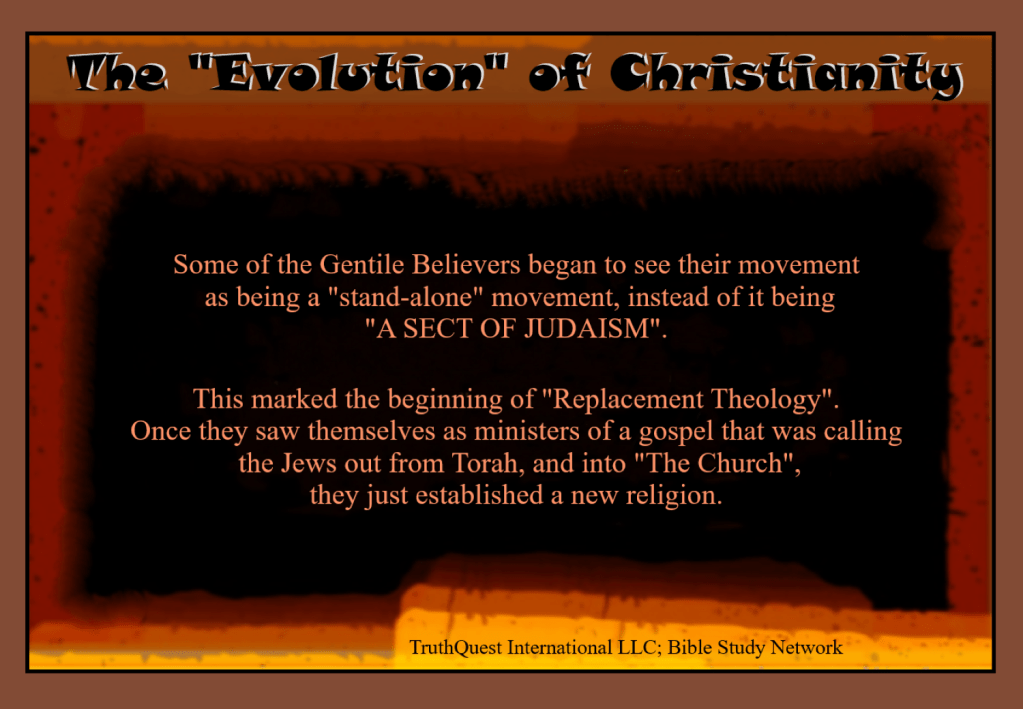
- Ignatius is presented as the first Gentile bishop to detach the Gospel from Torah, creating the early blueprint for Replacement Theology.
- A second historical layer examines Marcion, whose dual‑god theology and edited canon fully severed the Gospel from the Hebrew Scriptures.
- The study traces how Roman persecution, Jewish identity criminalization, and political pressures accelerated Gentile detachment from Jewish roots.
- It documents how Justin Martyr, Melito, Tertullian, Cyprian, Barnabas, and Origen progressively codified Supersessionism.
- The analysis concludes that Messiah did not establish a “replacement religion,” but a Jewish, Torah‑anchored walk later overwritten by imperial Christianity.
Training Orientation: The study is part of a 13‑block training system designed to reattach believers to the Jewish context of the New Testament and reject the distortions produced by Replacement Theology.
Did Messiah establish the same Torah compliant walk for the Gentiles Believers, as he did for the Believing Jews?
(Matthew 5:17-19)
Our start will be Acts 15:21 which is one of the proof texts that Messianic Judaism uses. Here we will attempt to understand whether the Believing Gentiles and the Believing Jews had the exact same walk in 50 A.D. following the Council of Acts 15.
“For Moses of old time hath in every city them that preach him, being read in the synagogues every sabbath day.”
The first question that needs to be addressed is:
Are the four prohibitions required for Salvation, since the debate was over the conditions for salvation?
“But there rose up certain of the sect of the Pharisees which believed, saying, That it was needful to circumcise them, and to command them to keep the law of Moses. And the apostles and elders came together for to consider of this matter.” (Acts 15:5-6)
“Wherefore my sentence is, that we trouble not them, which from among the Gentiles are turned to God. But that we write unto them, that they abstain from pollutions of idols, and from fornication, and from things strangled, and from blood.” (Acts 15:19-20)
Verse 29 answer this first question. These four parts of Torah were merely suggestions: “…from which if ye keep yourselves from, ye shall do well…”
Are they simply the first four parts of Torah they needed to know before going into the Synagogues in Antioch where they would learn all of it?
Acts 15:21 is a proof text for Messianic Judaism to support their belief that there is only one walk that Jews and Gentiles have.
“For Moses of old time hath in every city them that preach him, being read in the synagogues every sabbath day.”
Is James is telling them to start with these four and learn the rest of Torah on Sabbath in the Synagogues in Antioch, Syria.
We will look at Antioch, Syria fifty years later to see whether the Believing Gentiles were Torah Keepers.
____________________________________________
Ignatius of Antioch is traditionally believed to have died in Rome around 110 A.D., martyred during the reign of Emperor Trajan (98–117 A.D.). He was escorted from Antioch to Rome under military guard, and along the way, he wrote seven epistles to various congregations—letters that became foundational to early ecclesiology and the institutional shift toward bishop-centered authority, and severing the Gospel from Torah, calling Jewish practices obsolete.
His detachment erased the symbolic continuity that anchored Messiah to the Law, the Prophets, and the Psalms, and truly created another Saviour altogether to serve. Ignatius may rightly be seen as the first Gentile Bishop to detach himself—not just personally, but institutionally—from the Jewish Messiah’s framework. And that detachment became the blueprint for centuries of replacement theology and ecclesiastical distortion. On his way to Rome, about 40 years or so from the death of The Apostle Paul, his writings testify against him as clearly being detached from Paul’s doctrines:
- In Magnesians 8.1, Ignatius writes: “If we still live according to Judaism, we admit that we have not received grace.” This equates Torah observance with a denial of grace, a stark theological rupture.
- He contrasts “Judaism” with “Christianity” (Magnesians 10.3), treating them as mutually exclusive systems—an innovation not found in Paul’s letters, where Torah and grace are in tension but not severed.
1. Boyarin’s Analysis
- Boyarin argues that Ignatius invented “Judaism” as a discardable category—no longer a covenantal identity but a set of obsolete practices.
- This semantic shift allowed the Gospel to stand without prophetic anchoring, breaking mnemonic continuity with the Law, Prophets, and Psalms.
________________________________________________________________________________________
ORIENTATION TO THIS TRAINING
These 13 blocks are studies in and of themselves and do not build upon each other. Study them in any order you wish.
We teach our Bible Students to reattach themselves to the Jewish context of the New Testament Scriptures and to reject the teachings of all those effected by the poison of “Replacement Theology”.
We always try to locate the foundational passages in the Old Testament, for what is written in the New Testament Bible. Our example of Mark 1:15 connecting to Daniel 2:44 is one of the best examples.
Example:
“The Gospel of the Kingdom of God” (Mark 1:15) has its’ foundation in the prophecy of Daniel in 2:44
Use the “NEXT PAGE BUTTON” to return to Step One, or the site logo to return to the homepage.



Leave a Reply