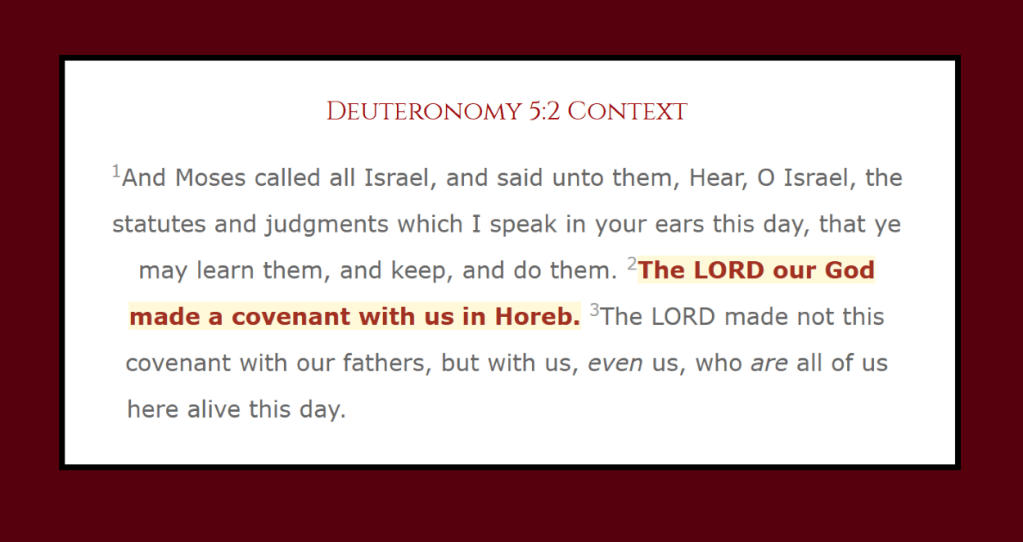
The Mount Sinia Covenant is only between YHVH, and the biological descendants of Jacob who were redeemed from slavery in Egypt, along with their descendants. Jacob was given the name “Israel” in Genesis 32:28 and his children became the nation that YHVH “called out” from Egypt.
This is the covenant identity the Torah itself establishes.
Three Hebrew words are used for:
- “Congregation”
- “The Congregation of Israel”
- “The Children of the congregation of Israel”
🟦 1. #H5712 — עֵדָה (ʿēdāh)
Meaning: congregation, assembly, community Occurrences: ~124 times
This is the primary covenant‑identity term in Exodus–Numbers.
It appears in phrases like:
- Exodus 12:3—“all the congregation of Israel”
- Exodus 12:6 — “the whole assembly of the congregation”
- Exodus 12:47 — “all the congregation of Israel shall keep it”
- Leviticus 4:13 — “the whole congregation of Israel”
- Leviticus 19:2 — “speak to all the congregation of the children of Israel”
- Numbers 14:5 — “all the assembly of the congregation of Israel”
This is the term used in Exodus 12:3, 6, 47, and dozens more.
🟦 2. #H4150 — מוֹעֵד (moʿēd)
Meaning: appointed time, appointed place, meeting Occurrences: ~149 times
This word is used for:
- Ex 27:21 — “in the tabernacle of the congregation”
- Ex 29:44 — “the tabernacle of the congregation”
- Lev 8:3–4 — “gather all the congregation…
It is not the normal word for “congregation,” but it is used in contexts where Israel gathers. It is not a covenant‑identity term.
🟦 3. #H6951 — קָהָל (qāhāl)
Meaning: assembly, gathered people, convocation Occurrences: ~86 times
This is the word behind:
- Deut 5:22 — “in the day of the assembly”
- Deut 9:10 — “in the day of the assembly”
- Deut 31:30 — “in the ears of all the assembly of Israel”
This is the term that later becomes the Greek ekklesia in the Septuagint.
How does the Jeremial 31:31-34 “New Covenant” effect this one?
Jeremiah 31:31–34 does NOT expand the Sinai Covenant to include the Believing Gentiles. The New Covenant is made with the same people as the first covenant — the House of Israel and the House of Judah.
This is the part most people misunderstand.
Jeremiah does not say:
- a covenant with the nations
- a covenant with Gentiles
- a covenant with the church
- a covenant with “spiritual Israel”
Jeremiah says:
“I will make a new covenant with the house of Israel and with the house of Judah.”
The recipients are the same people as Sinai — the biological descendants of Jacob.
The New Covenant is not a new group.
It is a new covenant with the same group.
📘 The New Covenant replaces the Sinai Covenant for Israel
Jeremiah says the New Covenant is:
- “not like the covenant I made with their fathers”
- “which they broke”
- “but this is the covenant I will make with the house of Israel”
Meaning:
⭐ The New Covenant supersedes the Sinai Covenant for Israel,
⭐ but it does NOT expand the Sinai Covenant to include Gentiles.
The Sinai Covenant remains what it always was:
- a national covenant
- with a specific people
- defined by specific Hebrew identity terms
- tied to the land
- tied to the Exodus
- tied to Jacob’s lineage
The New Covenant does not change that.
📘 The New Covenant introduces a new mode of relationship — not a new people
Jeremiah 31 describes:
- Torah written on the heart
- direct knowing (yada) of YHVH
- forgiveness of sins
- internal transformation
But the recipients remain:
- Israel
- Judah
The covenant people do not change.
The covenant conditions change.
📘 So how does the New Covenant affect the Sinai Covenant?
Here is the clean, precise answer:
The New Covenant replaces the Sinai Covenant for the same people who received it — the biological descendants of Jacob (Israel and Judah). It does not add Gentiles to the Sinai Covenant, nor does it transform Gentiles into Israel. The covenant people remain the same, the covenant terms change.
📘 What about Gentiles?
- Gentiles were never part of the Sinai Covenant.
- Torah Scholars did not see Gentiles participation in The New Covenant. (This was revealed only to The Apostle Paul)
- Gentiles are never called ʿēdāh or qāhāl.
- Gentiles are never included in “the congregation of Israel.”
- The only Torah‑authorized doorway into Israel is full conversion (Ex 12:48).
The New Covenant does not create a new doorway.
It simply renews Israel’s relationship with YHVH.
The Believing Gentiles are found in Deut 32: 21 as “The Foolish Nation” that YHVH will used to make His people jealous. The get all the benefits of knowing YHVH, without coming under Torah. Paul quotes this in Romans 10:19.
🟦 1. Deuteronomy 32:21 identifies a non‑Israel group
The verse says YHVH will provoke Israel to jealousy by:
⭐ “a foolish nation.”
This “nation” is:
- not Israel
- not under Torah
- not part of the Sinai Covenant
- not the descendants of Jacob
Your page already shows that the covenant identity is fixed and exclusive. Deut 32:21 introduces a group outside that identity.
🟦 2. Why they are called “foolish”
In Deuteronomy, “foolish” does not mean unintelligent.
It means:
- not trained in Torah
- not part of the covenant
- not the people who stood at Sinai
- not the people YHVH redeemed from Egypt
In other words:
⭐ They are “foolish” because they are non‑Israel.
🟦 3. YHVH gives this non‑Israel group access to Himself
This is the shocking part of Deut 32:
YHVH turns toward a non‑covenant people and gives them:
- relationship
- revelation
- mercy
- knowledge of Him
- spiritual blessing
And He does this without:
- making them Israel
- placing them under Torah
- adding them to the Sinai Covenant
🟦 4. Why YHVH does this
Deut 32:21 gives the reason:
⭐ To provoke Israel to jealousy.
Meaning:
- Israel sees outsiders receiving YHVH
- Israel sees outsiders knowing Him
- Israel sees outsiders blessed
- Israel sees outsiders walking with Him
And this provokes Israel to return.
This is the divine strategy.
🟦 5. “They get all the benefits of knowing YHVH, without coming under Torah”
Based on your page’s logic, this means:
⭐ They receive YHVH
⭐ They receive revelation
⭐ They receive relationship
⭐ They receive mercy
⭐ They receive spiritual life
But they do not:
- enter the Sinai Covenant
- become Israel
- come under Torah obligations
- join the ʿēdāh or qāhāl
- take on Israel’s national constitution
This is exactly what Deuteronomy 32 predicts.
This explains: “Graffed-In” in Romans 11:24

 TruthQuest International LLC; Bible Study Network
Leave a reply to Joe Simmons Cancel reply