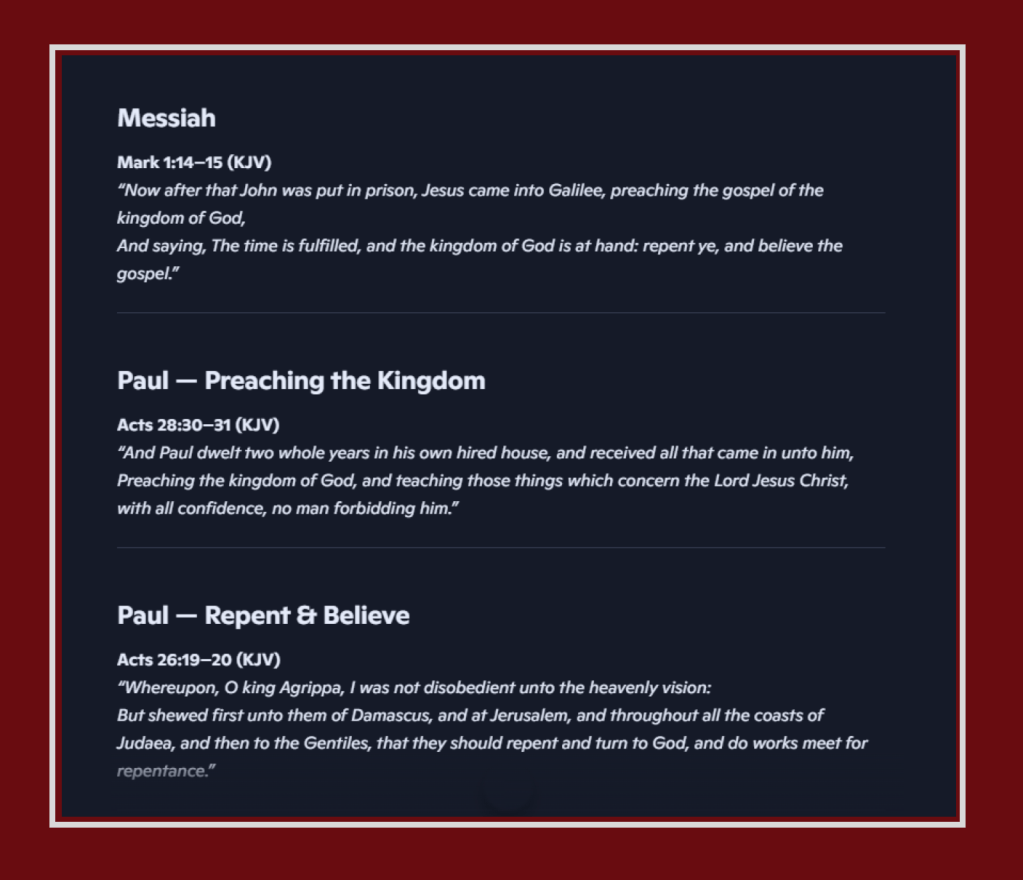
1. Acts 20:21 — Repentance & Faith (Mark 1:15)
“Testifying both to the Jews, and also to the Greeks, repentance toward God, and faith toward our Lord Jesus Christ.”
2. Acts 26:19–20 — Repent & Turn to God (Mark 1:15)
“…that they should repent and turn to God, and do works meet for repentance.”
3. Acts 28:30–31 — Preaching the Kingdom (Mark 1:14)
“…preaching the kingdom of God, and teaching those things which concern the Lord Jesus Christ…”
4. Romans 1:1 — Paul’s Gospel Is God’s Gospel
“…separated unto the gospel of God.”
5. Romans 1:16 — The Same Gospel Power
“For I am not ashamed of the gospel of Christ…”
6. Romans 2:16 — God Judges by Paul’s Gospel
“…God shall judge the secrets of men by Jesus Christ according to my gospel.”
7. Romans 10:8–11 — Believe the Gospel (Mark 1:15)
“…the word of faith, which we preach…”
8. 1 Corinthians 15:1–2 — The Gospel Paul Preached
“…I declare unto you the gospel which I preached unto you…”
9. 2 Corinthians 5:20 — Paul Speaks for Messiah
“…as though God did beseech you by us…”
10. Galatians 1:11–12 — Paul Received the Gospel From Messiah
“…the gospel which was preached of me is not after man… but by the revelation of Jesus Christ.”
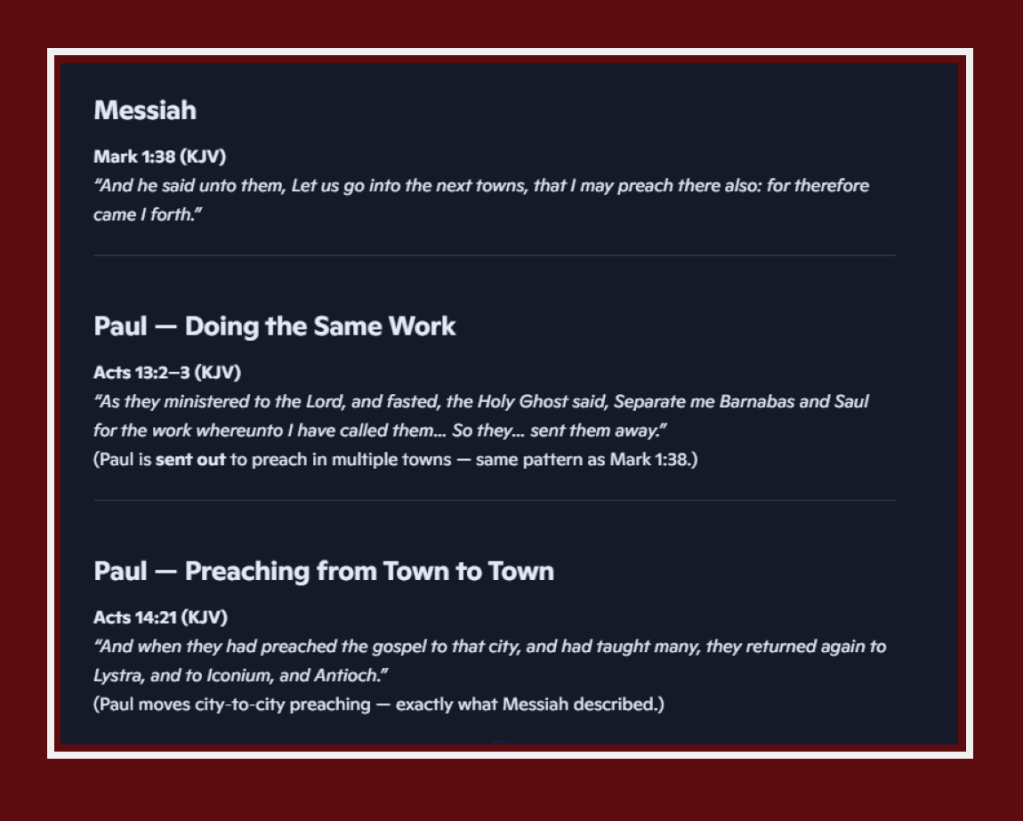
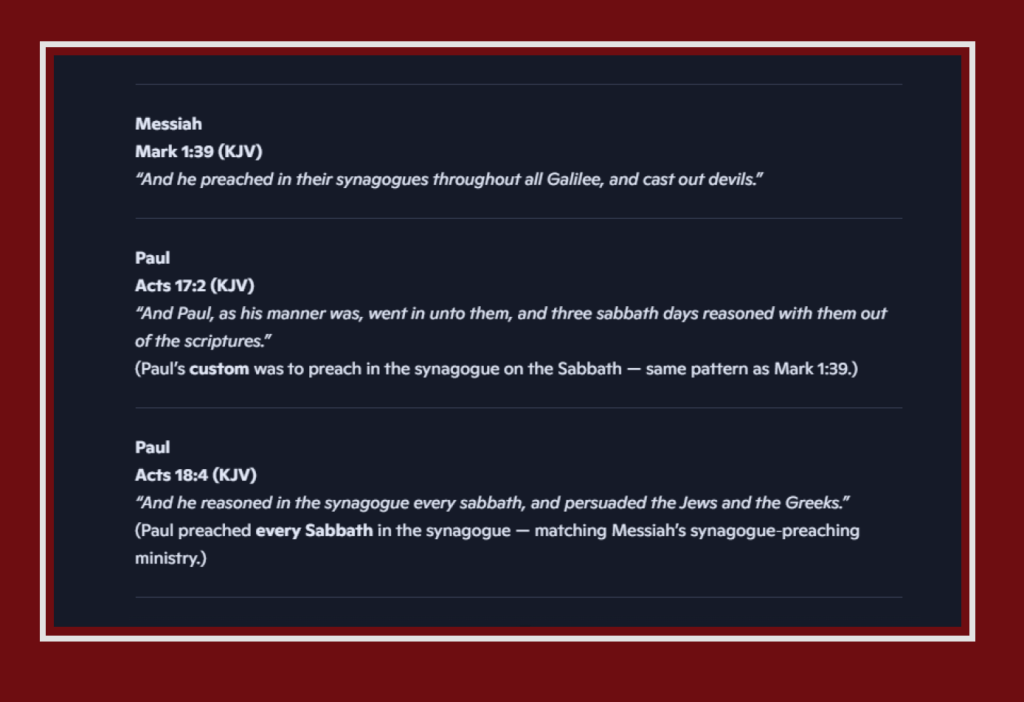
This comparison is very obvious.
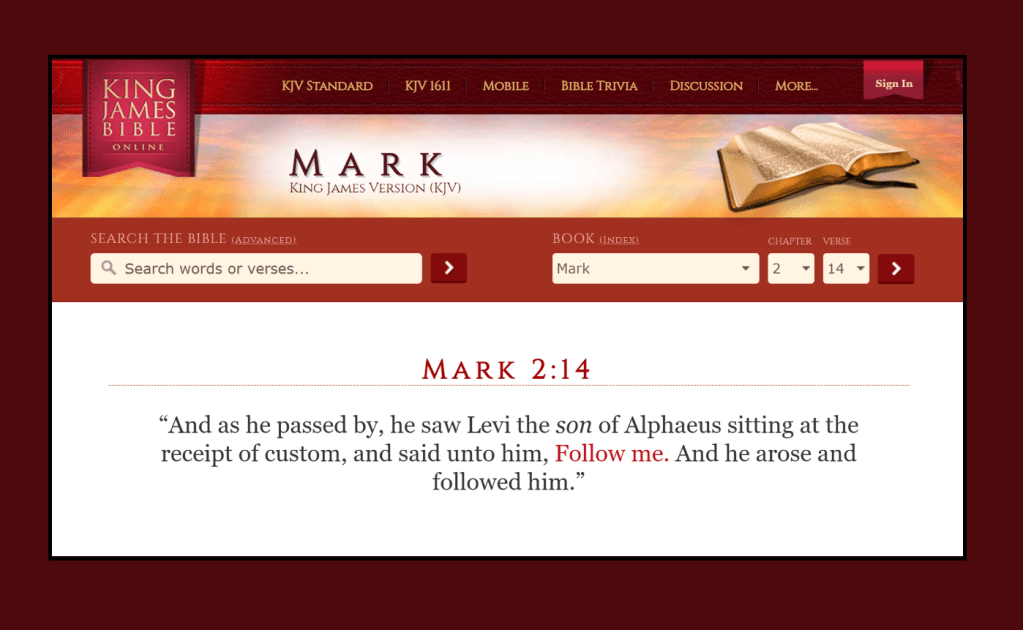
🕎 THE JEWISH MEANING OF “FOLLOW ME”
Elijah → Elisha as the Discipleship Pattern
In Jewish prophetic culture, “Follow me” was not a casual invitation. It was a formal call to discipleship, meaning:
- Leave your previous life
- Attach yourself to the prophet
- Learn his halakhah (way of life)
- Receive his authority
- Continue his mission
This is exactly what happens in 1 Kings 19:19–21:
- Elijah passes by Elisha
- Elijah casts his mantle on him
- Elisha leaves everything
- Elisha follows Elijah
- Elisha becomes his successor and authorized representative
In Jewish thought, this is the gold‑standard pattern of prophetic discipleship.
🧩 KEY JEWISH ELEMENTS OF “FOLLOWING” A PROPHET
1. Physical Following = Jurisdictional Submission
To “follow” meant to walk behind the prophet as a sign of:
- Submission to his authority
- Acceptance of his teaching
- Commitment to his mission
2. Learning the Prophet’s Way
A disciple learned:
- His teacher’s interpretation
- His teacher’s rulings
- His teacher’s lifestyle
- His teacher’s prophetic calling
3. Receiving the Prophet’s Spirit
Elisha receives a double portion of Elijah’s spirit. This is the Jewish expectation:
The disciple carries forward the master’s work.
4. Representing the Prophet
A disciple becomes a shaliach — an authorized agent. Whatever the disciple does in the name of the master is considered the master’s own action.
This is the background for Paul’s apostleship.
✡️ YESHUA USES THE SAME JEWISH FORMULA
When Yeshua says:
“Follow Me.” (Mark 2:14)
He is using the Elijah → Elisha pattern:
- Leave your old life
- Attach yourself to the Messiah
- Learn His way
- Receive His Spirit
- Continue His mission
This is why the disciples immediately leave everything — they recognize the prophetic call.
⭐ PAUL USES THE SAME JEWISH FORMULA FOR GENTILES
Paul deliberately uses the Elijah → Elisha → Yeshua pattern when he says:
“Be followers of me, as I also am of Messiah.” 1 Corinthians 11:1
This is not arrogance. It is Jewish discipleship logic:
- Messiah is the greater Elijah
- Paul is the Elisha‑figure sent to the nations
- Gentiles follow Paul as he follows Messiah
- This is the authorized chain of transmission
Paul is not replacing Messiah. He is functioning as Messiah’s shaliach — His authorized representative.
Just as:
- Elisha followed Elijah
- And Israel followed Elisha
- So Gentiles follow Paul
- Because Paul follows Messiah
This is the Jewish discipleship structure behind Paul’s command.
🎯 THE ONE‑SENTENCE SYNTHESIS
The Jewish meaning of “Follow Me” comes from Elijah calling Elisha into prophetic discipleship, and Paul applies this same pattern when he tells Gentiles to follow him as he follows Messiah — a chain of authorized transmission rooted in Jewish prophetic tradition.
“Be ye followers of me, even as I also am of Christ.”
Here, Paul uses the Jewish discipleship formula — the same pattern as Messiah calling Levi: follow the teacher to learn his way. (I Corinthians 11:1)
“And ye became followers of us, and of the Lord…”
Paul frames discipleship exactly like Elisha following Elijah — a chosen student walking behind the prophet to receive and transmit his teaching. (I Thessalonians 1:6)
The Twelve followed Messiah in person for three years. We receive that same discipleship experience through following Paul, because the Holy Spirit uses Paul’s teachings to form Messiah’s life in us. What the Twelve learned by walking behind Messiah physically, we learn by walking behind Paul spiritually — the same pattern as Elisha following Elijah, a chosen disciple receiving the prophet’s instruction through the Spirit.
🍷 Where Paul teaches the “New Wine / Old Wineskins” principle to Gentiles
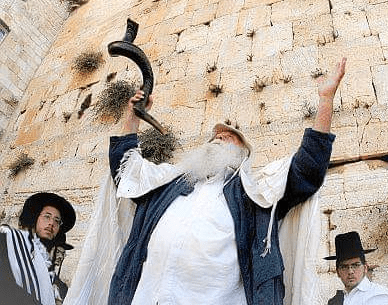
The “Jewish Identity Markers”, as seen in the Temple Mount photo, show us clearly that the Gentile Believers are not to try to “OBEY TORAH”.
Paul never quotes the parable directly, but he teaches the exact same principle — covenantal incompatibility — in one place more clearly than anywhere else:
⭐ Galatians 3:1–5; 3:10–14; 4:21–31; 5:1–4
These four sections together are Paul’s Gentile‑direct teaching of the “new wine cannot go into old wineskins” principle.
Below is the modular breakdown you can drop straight into your teaching system.
🧩 1. Galatians 3:1–5 — You received the Spirit without Torah
New Wine: The Spirit, received by faith. Old Wineskin: Torah‑works as covenant entry.
Paul’s argument:
- Gentiles received the Spirit without Torah
- Therefore adding Torah afterward is a category error
- Mixing the two “makes the work of the Spirit vain”
This is the wineskin metaphor in apostolic form.
🧩 2. Galatians 3:10–14 — Torah brings a curse if you enter it
Paul states:
- “As many as are of the works of the law are under the curse”
- Torah demands all or nothing
- Christ redeemed Gentiles from that system
This is exactly Yeshua’s logic: Old wineskin = Sinai system that bursts if you pour New Covenant life into it.
🧩 3. Galatians 4:21–31 — Two covenants cannot be mixed
This is Paul’s most explicit “wineskin” teaching.
- Hagar = Sinai = slavery
- Sarah = promise = Spirit
- “Cast out the bondwoman and her son”
- The two covenants cannot coexist in the same household
This is the apostolic version of:
“New wine must be put into new wineskins.”
🧩 4. Galatians 5:1–4 — If you take Torah, Christ profits you nothing
Paul tells Gentiles:
- “Stand fast in the liberty”
- “Be not entangled again with the yoke of bondage”
- “If you be circumcised, Christ shall profit you nothing”
- “You are fallen from grace”
This is the strongest possible statement of covenantal incompatibility.
You cannot pour the New Covenant into the Sinai Covenant. It destroys both.
Exactly Yeshua’s metaphor.
🎯 The one‑sentence answer for your post
Paul teaches the “new wine / old wineskins” principle to Gentiles in Galatians 3–5, where he argues that the New Covenant of the Spirit cannot be mixed with the Sinai Covenant of Torah without destroying both systems.
⭐ “Serve in newness of Spirit, not in oldness of letter.”
Romans 7:6
This integrates perfectly with the wineskin metaphor you have open in Mark 2:22 .
Below is the copy‑ready teaching block you can drop directly into your system.
🍷 NEW WINE / NEW WINESKINS — PAUL’S VERSION
Romans 7:6 — “Newness of Spirit” vs. “Oldness of Letter”
Paul gives the apostolic explanation of Yeshua’s wineskin parable.
Where Yeshua says:
- New wine cannot go into old wineskins (Mark 2:22)
Paul says:
We serve in newness of Spirit, not in oldness of letter (Romans 7:6)
Paul is not interpreting the parable — he is teaching the same principle directly to Gentiles.
🧩 1. Romans 7:6 — The Covenant Shift
Paul states:
- The oldness of the letter = the Sinai covenant system
- The newness of the Spirit = the New Covenant jurisdiction
- You cannot serve God under both systems at once
This is the wineskin principle in apostolic form:
The Spirit is the new wine. The Sinai covenant is the old wineskin. They cannot be mixed.
🧩 2. Romans 7:7–11 — The Letter Produces Death
Paul explains why the “old wineskin” bursts:
- The letter awakens sin
- The commandment kills
- The law condemns
- The system cannot contain the Spirit’s life
This is exactly what Yeshua described:
Old wineskins cannot hold new wine — they rupture.
Paul’s version:
The letter cannot hold the Spirit — it produces death.
🧩 3. Romans 8:1–4 — The Spirit Fulfills What the Letter Could Not
Paul then shows the positive side:
- The Spirit fulfills the righteousness of the law
- The Spirit empowers obedience
- The Spirit produces life
- The Spirit replaces the written code as the governing power
This is the “new wineskin” reality:
New wine must be put into new wineskins.
Paul’s version:
We must serve in newness of Spirit, not in oldness of letter.
🧩 4. Romans 2:14–15 — Gentiles Already Show the Principle
Paul tells Gentiles:
- They do by nature the things contained in the law
- Without being under the law
- Because the Spirit writes the moral core on the heart
This is the New Covenant’s internal wineskin.
Gentiles do not need the Sinai system because:
The Spirit is the new container for obedience.
🎯 THE ONE‑SENTENCE SYNTHESIS
Paul teaches Yeshua’s “new wine / old wineskins” principle in Romans 7:6 by declaring that believers must serve God in the newness of the Spirit, because the oldness of the letter — the Sinai covenant — cannot contain or sustain New Covenant life.
the contrast between:
- Messiah teaching Jews under Torah (Mark 10:17–27)
- Paul teaching Gentiles under the New Covenant (Acts 16:30–31)
This is one of the clearest places in Scripture where the two jurisdictions cannot be blended.
🟦 1. Messiah’s Audience: Jews Under Torah
Mark 10:17–27 — “What must I do to inherit eternal life?”
A Torah‑keeping Jew asks Messiah a Torah‑jurisdiction question:
“Good Master, what shall I do that I may inherit eternal life?”
Messiah answers exactly as Torah requires, because:
- He is speaking to a Jew under the Sinai covenant
- The man is asking about covenant inheritance
- Eternal life for Israel was tied to Torah faithfulness
- Messiah is functioning as a Torah‑teacher to Torah‑people
So Messiah responds:
- “You know the commandments…”
- “Do not commit adultery…”
- “Do not kill…”
- “Do not steal…”
- “Honor thy father and mother…”
This is not New Covenant doctrine. This is Torah‑covenant maintenance for a Jew still under the law.
Messiah is not giving a Gentile salvation formula. He is giving a Sinai‑covenant answer to a Sinai‑covenant man.
🟦 2. Paul’s Audience: Gentiles Under the New Covenant
Acts 16:30–31 — “What must I do to be saved?”
A Gentile jailor asks Paul the same question — but under a different covenant:
“Sirs, what must I do to be saved?”
Paul does not quote commandments. He does not mention Torah. He does not tell him to keep the law.
Paul gives the New Covenant salvation command:
“Believe on the Lord Jesus Christ, and thou shalt be saved.” Acts 16:31
This is the Gentile‑jurisdiction answer:
- No Torah
- No commandments
- No covenant inheritance language
- No Sinai obligations
Just:
- Believe
- On the Lord Jesus Christ
- And you will be saved
This is the New Covenant entrance requirement, not the Sinai covenant maintenance requirement.
🟦 3. Why the Answers Are Different
Because the audiences and covenants are different.
Messiah in Mark 10
- Speaking to Jews under Torah
- Teaching Torah’s requirements
- Operating before the cross
- Within the Sinai covenant
Paul in Acts 16
- Speaking to Gentiles outside Torah
- Teaching New Covenant salvation
- After the cross and resurrection
- Under Spirit‑based righteousness
The question is similar. The jurisdiction is not.
Same question. Different people. Different covenants. Different answers.
🟦 THE ONE‑SENTENCE SYNTHESIS
Messiah taught Jews under Torah what Torah required; Paul taught Gentiles under the New Covenant what faith in Christ required — which is why Mark 10 commands obedience to Torah, while Acts 16 commands belief in Christ alone.
📘 MARK → TAUGHT BY PAUL
Beginning at Mark 2:23 and continuing through the entire Gospel
Below is the outline only — each bullet shows:
- Mark reference
- Messiah’s teaching
- Paul’s Gentile‑direct parallel
- Where to read it
MARK 2:23–28 — LORD OF THE SABBATH
Messiah’s point: Authority over Sabbath; human need > ritual.
Paul teaches:
- Colossians 2:16–17 — Gentiles not judged by Sabbaths
- Romans 14:5 — days optional
- Galatians 4:10–11 — warning against returning to Jewish calendar
MARK 3 — DOING GOOD ABOVE RITUAL
Messiah: Doing good is lawful always.
Paul:
- Galatians 5:13–14 — love fulfills the law
- Romans 13:8–10 — love does no harm
- 1 Thessalonians 5:15 — pursue good
MARK 4 — PARABLES & HEARING
Messiah: Hear, understand, receive the word.
Paul:
- Romans 10:17 — faith comes by hearing
- 1 Corinthians 2:12–13 — Spirit teaches
- Colossians 1:5–6 — gospel bears fruit
MARK 5 — FAITH & DELIVERANCE
Messiah: “Fear not, only believe.”
Paul:
- Acts 16:31 — “Believe on the Lord Jesus Christ…”
- Romans 1:16–17 — righteousness by faith
- Galatians 3:2 — Spirit received by faith
MARK 6 — UNBELIEF & COMMISSION
Messiah: Unbelief limits; disciples sent to preach repentance.
Paul:
- Romans 11:20 — unbelief cuts off
- Acts 20:21 — repentance & faith
- 2 Corinthians 5:20 — ambassadors sent
MARK 7 — CLEAN & UNCLEAN
Messiah: Not what goes in, but what comes out.
Paul:
- Romans 14:14 — nothing unclean of itself
- 1 Timothy 4:3–5 — foods sanctified
- Titus 1:15 — to the pure all things pure
MARK 8 — TAKE UP YOUR CROSS
Messiah: Deny yourself; follow Me.
Paul:
- Romans 6:6 — old man crucified
- Galatians 2:20 — crucified with Christ
- Philippians 3:10 — fellowship of His sufferings
MARK 9 — HUMILITY & SERVANTHOOD
Messiah: Be last; serve all.
Paul:
- Philippians 2:3–7 — Christlike humility
- Galatians 5:13 — serve one another
- Romans 12:10 — prefer one another
MARK 10 — RICHES, KINGDOM, & SALVATION
Messiah: Torah answer to a Torah‑keeper.
Paul:
- Acts 16:31 — salvation by faith
- Romans 3:21–26 — righteousness apart from law
- Ephesians 2:8–9 — saved by grace
MARK 11 — FORGIVENESS & FAITH
Messiah: Forgive; pray believing.
Paul:
- Ephesians 4:32 — forgive as Christ forgave
- Colossians 3:13 — forgive one another
- 1 Timothy 2:8 — pray without wrath
MARK 12 — LOVE GOD & NEIGHBOR
Messiah: Greatest commandments.
Paul:
- Romans 13:8–10 — love fulfills the law
- Galatians 5:14 — whole law fulfilled in love
- 1 Corinthians 13 — supremacy of love
MARK 13 — WATCHFULNESS
Messiah: Be alert; be ready.
Paul:
- 1 Thessalonians 5:1–6 — watch and be sober
- Titus 2:13 — looking for blessed hope
- Colossians 3:4 — Christ our appearing
MARK 14 — THE NEW COVENANT
Messiah: “This is my blood of the New Covenant.”
Paul:
- 1 Corinthians 11:23–26 — Lord’s Supper
- 2 Corinthians 3:6 — ministers of New Covenant
- Romans 7:6 — newness of Spirit
MARK 15 — THE CROSS
Messiah: Atoning death.
Paul:
- Romans 5:8–10 — reconciled by His death
- 1 Corinthians 1:18 — preaching of the cross
- Galatians 6:14 — glory in the cross
MARK 16 — THE GOSPEL TO ALL NATIONS
Messiah: Preach the gospel to every creature.
Paul:
- Romans 1:5 — apostleship to the nations
- Romans 15:16 — minister to Gentiles
- Colossians 1:23 — gospel preached to every creature
 TruthQuest International LLC; Bible Study Network
Leave a comment