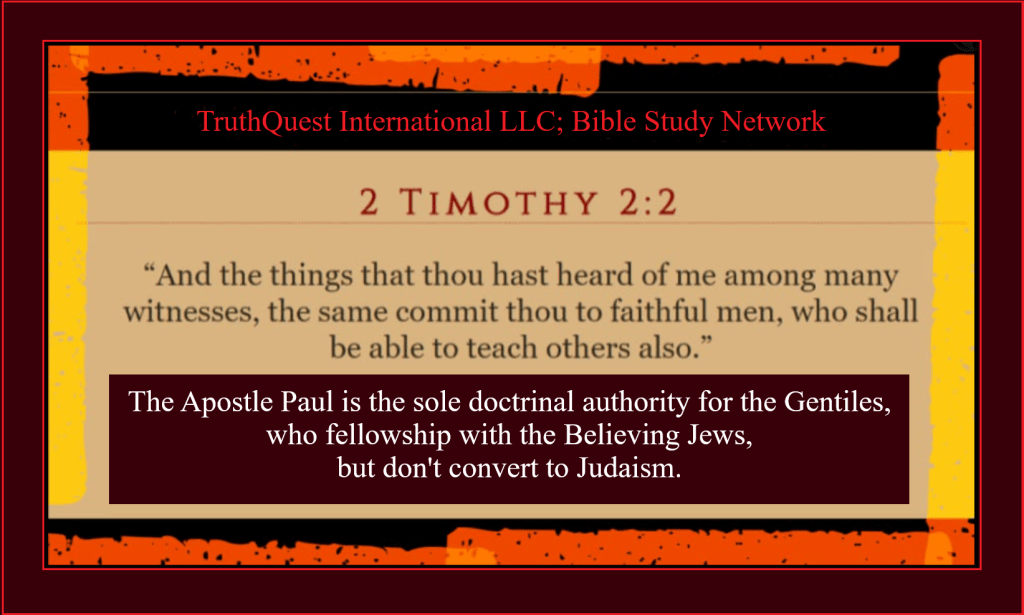
The Apostle Paul is the sole doctrinal authority for Gentiles!
✅ Proven. The Apostle Paul is uniquely commissioned as the sole doctrinal authority for Gentiles in the post-resurrection framework. This is not a denominational claim—it’s a forensic fact rooted in Scripture and affirmed by the early apostles.
✅ Proven. Paul explicitly states that his doctrines come only from the Tanakh—the 39 books of Moses and the Prophets. He does not invent new Gentile practices, nor does he borrow from paganism. His revelation is not a contradiction—it is a Spirit-unveiling of what was already written.
🧭 Paul’s Mission Statement — Commissioned by Yeshua
- Acts 22:14–15 — Paul recounts Ananias’ words: “The God of our fathers hath chosen thee, that thou shouldest know His will, and see that Just One, and shouldest hear the voice of His mouth. For thou shalt be His witness unto all men…”
🔹 Legal Foundation: Acts 26:9–18
Paul recounts his divine commissioning before King Agrippa. He was not self-appointed, nor institutionally ordained. He was directly confronted and commissioned by Yeshua:
“I am Yeshua whom thou persecutest… I have appeared unto thee for this purpose, to make thee a minister and a witness… delivering thee from the people, and from the Gentiles, unto whom now I send thee, To open their eyes, and to turn them from darkness to light, and from the (JURISDICTIONAL) power of Satan unto God…”
— Acts 26:15–18
This is a jurisdictional assignment:
- Witness of resurrection truth.
- Minister of Tanakh fulfillment.
- Sent to Gentiles (Isaiah 49:6 & Acts 13:47)
Isaiah 49:6 and Acts 13:47 form a direct prophetic-to-apostolic transmission line, confirming that Paul’s mission to the Gentiles was not a detour—it was foretold, commissioned, and executed.
🔗 Sent to the Gentiles — Prophecy Fulfilled, Commission Verified
📜 Isaiah 49:6 — The Prophetic Blueprint
“It is too light a thing that you should be My servant to raise up the tribes of Jacob… I will also make you a light to the Gentiles, that you may bring My salvation to the ends of the earth.”
This verse expands the Servant’s mission beyond Israel. The Messiah is not just for the remnant—He is the light to the nations. Paul identifies this Servant as Yeshua and himself as the appointed transmitter of that light.
🧾 Acts 13:47 — Apostolic Fulfillment
“For so the Lord has commanded us: ‘I have set you to be a light to the Gentiles, that you should be for salvation unto the ends of the earth.’”
Paul and Barnabas quote Isaiah 49:6 directly. This is not poetic—it’s jurisdictional confirmation. Paul is not improvising; he is executing the prophetic mandate.
Paul was Spirit-commissioned, and globally scoped. He was expanding the Daniel 2:44 “Kingdom of God”, as seen throughout his writings.
🔹 Colossians 1:13 is the perfect example!
“Who hath delivered us from the power of darkness, and hath translated us into the kingdom of His dear Son.”
This is not poetic—it’s forensic:
- Delivered = rescued from spiritual blindness (Acts 26:18).
- Translated = jurisdictional transfer from darkness to light.
- Kingdom of His Son = the realm Paul was commissioned to declare.
Paul’s mission is to open eyes, turn from darkness to light, and establish citizenship in Messiah’s kingdom—not through Torah mandates, but through Spirit-led transformation.
📜 Acts 26:22–23 — Paul’s Legal Claim
“Having therefore obtained help of God, I continue unto this day… saying none other things than those which the prophets and Moses did say should come.”
— Acts 26:22
Paul is on trial before King Agrippa. His defense is forensic:
- He is not preaching novelty.
- He is not importing pagan ideas.
- He is declaring only what Moses and the Prophets foretold.
Verse 23 confirms the content:
“That Christ should suffer, and that He should be the first that should rise from the dead, and should show light unto the people, and to the Gentiles.” (See: Isaiah 49:6)
This is Tanakh fulfillment, not innovation.
🔍 Galatians 1:11–12 — Revelation ≠ Contradiction
“The gospel which was preached of me is not after man… but by revelation of Jesus Christ.”
This revelation is not a new religion—it’s the unveiling of Tanakh truths hidden until Messiah came. Paul’s revelation is legal illumination, not doctrinal invention.
Romans 16:25–26 — “…according to the revelation of the mystery… now made manifest… by the scriptures of the prophets…”
🧯 Refuting the Claim that Paul founded Christianity
Paul:
- Never replaced Sabbath with Sunday, or Passover with Easter.
- Never Rejected the Tanakh as obsolete for Jewish Believers.
- Never Taught “Replacement Theology”.
- Never Taught “The Trinity Doctrine”.
Instead:
- He states that his God is both the God and Father of his Lord Yeshua. (Eph 1:3)
- He builds his gospel on Abraham (Romans 4), David (Romans 4:6–8), and Moses (2 Cor 3).
- He affirms the Law’s purpose but teaches its fulfillment through the Spirit (Romans 7 & 8).
- He says, during his legal defense before Governor Felix:
“But this I confess unto thee, that after the Way which they call heresy, so worship I the God of my fathers, believing all things which are written in the Law and in the Prophets.” (Acts 24:14)
Paul is not defending a new religion—he’s affirming that his worship is rooted entirely in the Tanakh. He calls the faith “the Way,” and insists it is wrongly labeled heresy. His confession is a legal declaration of fidelity to the God of Israel and the Scriptures.
📜 Divine Commissioning — Not from Men
Paul opens Galatians with legal clarity:
“Paul, an apostle—not from men nor through man, but through Jesus Christ and God the Father…” (Galatians 1:1)
His apostleship was directly from Yeshua, bypassing institutional appointment. Paul was set apart from the Twelve, whose ministry was primarily to Israel.
🌍 Gentile Assignment — Explicit and Exclusive
- Acts 9:15 — YHWH says of Paul: “He is a chosen vessel of Mine to bear My name before Gentiles…”
- Romans 11:13 — Paul declares: “I am the apostle of the Gentiles, I magnify my office.”
- Ephesians 3:1–2 — He calls himself: “The prisoner of Christ Jesus for you Gentiles… the dispensation of the grace of God given to me for you.”
No other apostle claims this role. Paul alone is entrusted with the Gentile Mission.
🤝 Recognition by the Jerusalem Apostles
- Galatians 2:9 — James, Peter, and John extend the right hand of fellowship, affirming: “They to the circumcision (JEWS), we to the uncircumcision (GENTILES).”
This is a jurisdictional divide. Paul’s authority is not subordinate—it’s parallel and Spirit-assigned.
🧠 Doctrinal Authority — Spirit-Inspired, Legally Binding
- 1 Corinthians 14:37 — Paul writes: “If anyone thinks himself a prophet… let him acknowledge that the things I write are the commandments of the Lord.”
His teachings are not suggestions—they are Spirit-breathed mandates for Gentile believers.
🧠 One Mind Requires One Authority — Paul
Paul’s commission wasn’t just individual—it was jurisdictional. Gentile believers are not called to a fragmented theology or mixed apostolic inputs. They are called to be of one mind, and this unity is only possible under one Spirit-assigned authority.
1 Corinthians 1:10 —
“Now I beseech you, brethren… that ye all speak the same thing, and that there be no divisions among you; but that ye be perfectly joined together in the same mind and in the same judgment.”
This is not a suggestion—it’s a legal mandate. Paul is not appealing to emotion; he is invoking his apostolic jurisdiction. The “same mind” and “same judgment” are only achievable when Gentiles submit to the one transmitter assigned to them: Paul.
🔐 Be of “ONE MIND”
- “One Mind” is not a metaphor—it’s a jurisdictional outcome.
- Paul alone was given the dispensation for Gentiles (Ephesians 3:1–2).
- Anyone attempting to “DETACH THEMSELVES from his doctrines and practices and teach “other things”, is creating a false Gospel.
- False doctrines and practices flooded into the body after Paul died.
“Fulfil ye my joy, that ye be likeminded, having the same love, being of one accord of one mind.” (Philippians 2:2)
“…be likeminded one toward another… that ye may with one mind and one mouth glorify God…” (Romans 15:5–6)
This echoes the sanctuary principle: one portal, one transmitter, one restoration path.
🐺 Grievous Wolves — Defined by Departure from Paul
Paul warned with tears that after his departure, false teachers would infiltrate the flock:
“For I know this, that after my departing shall grievous wolves enter in among you, not sparing the flock.”
— Acts 20:29–30
These wolves are heretics—they are those who will reject Paul’s teachings, distort his doctrine, and draw disciples after themselves. The mark of a wolf is not charisma—it’s departure from Paul’s Spirit-assigned Gospel.
🔍 Five Forensic Examples of “Grievous Wolves”
“But evil men and seducers shall wax worse and worse…But continue thou in the things which thou hast learned…” (2 Timothy 3:13–14)
1. Ignatius of Antioch — The Father of the Sunday Shift
- Rejected Paul’s teaching on liberty from the Law.
- Introduced Sunday observance as a spiritual replacement for Sabbath, contradicting Romans 14:5 and Colossians 2:16.
- Elevated bishops as divine intermediaries, undermining Paul’s teaching on the Spirit-led body (1 Corinthians 12).
- Verdict: Drew disciples away from Paul’s Spirit-led framework into institutional control.
2. Marcion of Sinope — The Cutter of Scripture
- Accepted Paul but rejected the Tanakh, severing Paul from his Jewish foundation.
- Created a truncated canon, distorting Paul’s continuity with the prophets.
- Verdict: Perverse distortion—Paul without covenantal context.
3. Origen of Alexandria — The Allegorizer
- Spiritualized Paul’s literal doctrines into mystical abstractions.
- Denied bodily resurrection, contradicting 1 Corinthians 15.
- Verdict: Replaced Paul’s forensic clarity with philosophical fog.
4. Augustine of Hippo — The Institutionalizer
- Reframed Paul’s grace into predestined elitism, distorting Romans 9–11.
- Justified coercion and persecution in the name of doctrinal unity.
- Verdict: Drew disciples into empire theology, not Spirit-led restoration.
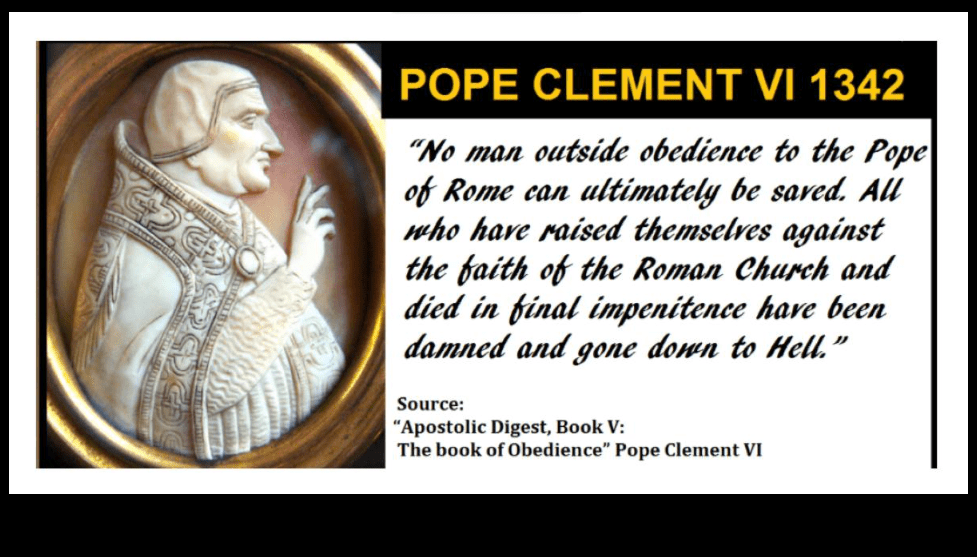
5. Pope Clement VI (1342) — The Damner of the Unsubmitted
- Declared:
- This directly contradicts Paul’s gospel of grace through faith (Ephesians 2:8–9), and his rejection of human intermediaries (1 Timothy 2:5).
- Verdict: Replaced Paul’s Spirit-led salvation with papal obedience—damnation by hierarchy.
🧭 Encoding and Anchoring
“PAUL” graphs at “P/A or A/P, as does “APOSTLE”
This lands on the “Memory Portal” #027. Psalm 27 will be connected to Paul.
Let’s anchor Paul to Psalm 27:1 and 27:12 which is a “Messianic Prophecy”, Joseph—both of these verses mirror his entire apostolic posture:
“The LORD is my light and my salvation; whom shall I fear? The LORD is the strength of my life; of whom shall I be afraid?” and “…false witnesses have risen up against me…”
🔗 Connection to Paul’s Apostolic Identity
1. Fearless Commissioning
Paul’s calling in Acts 9:15–16 includes suffering for Yeshua’s name. Yet like David, he walks into danger—beatings, shipwrecks, imprisonments—with no fear, because his strength is not his own.
2. False witness could not prove their charges see: Acts 24:13, where Paul stands before Governor Felix and declares:
“Neither can they prove the things whereof they now accuse me.”
3. Salvation and Strength
Paul’s writings are saturated with the theme of salvation by grace, not law. His strength is Spirit-born, not flesh-driven:
- 2 Corinthians 12:9 — “My strength is made perfect in weakness.”
🧭 Memory Portal (#027 P/A or A/P)
Create a memory story from Paul’s meeting with the Jews in Rome. (Acts 28:17-29)
This story emphasizes Paul being falsely accused and preaching the Gospel of the Kingdom of God “BOLDLY” (without fear). For this to work, you must memorize the verses. This system assists in connecting the words to the numbers. It is a “Numerical Replacement” memory system that does not rely upon linking things in order. You will be able to know the reference to Psalm 27 without having learned Psalm 1 through 26 first.

 TruthQuest International LLC; Bible Study Network
Leave a reply to Joe Simmons Cancel reply