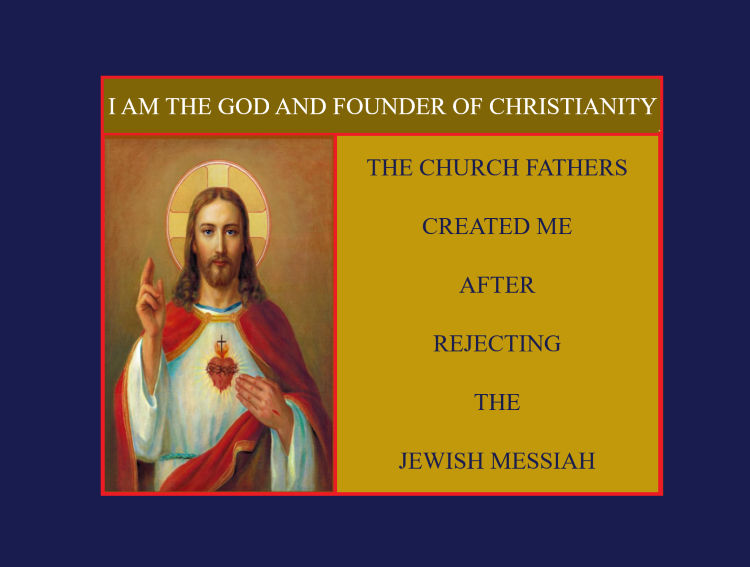
Introduction to Bible Studying
The Word of God entered the world as a real human being: “The Last Adam”. (“The son of man”) This was required in order to restore the jurisdictional power back to YHVH that Adam lost to Satan in the Garden— and to fulfill hundreds of other prophetic declarations. (See Image Right) Why? By releasing all divine privilege (except memory) and living as a sinless man, He created the legal condition under which Satan would forfeit the jurisdictional authority he held over humanity. A sinless human being, murdered under Satan’s influence, collapses the adversary’s legal claim. This is the foundation of the Jurisdictional Paradigm.
The Gospel of John begins our teaching of YHVH sending His Word on this “RECOVERY MISSION”, but it takes many other passages to complete this study. Knowing the Jewish law of “Shaliach” is essential to understanding the implications of YHVH authorized His Word to represent Him in our “The Physical Realm” as the biological descendant of King David.
In Jewish law, a shaliach (שָׁלִיחַ) is an authorized agent who carries the full authority of the one who sent him. The legal principle is:
“The agent is as the one who sent him.”
This is not identity of personhood. It is identity of authority.
So when Yeshua says:
“If you have seen Me, you have seen the Father” (John 14:9)
He is speaking as the Father’s authorized shaliach, not claiming to be the Father.
He means:
“If you want to know the will, character, intentions, and authority of the One who sent Me, look at Me — because I am His authorized representative.”
“ONE NEW MAN”(Eph 2:15) We both have access to YHVH by His Spirit (Eph 2:18) However we are NOT to eat the same foods, dress the same, look the same, but we both are to be led by The Holy Spirit. Paul taught that the Jews were to remain “TORAH KEEPERS”, but the Gentiles were NOT to try to imitate them. (I Cor 7:17-20)
The Word is sent into the physical realm as YHVH’s authorized Agent (shaliach), becoming “The Last Adam.” (John 1:1-14)
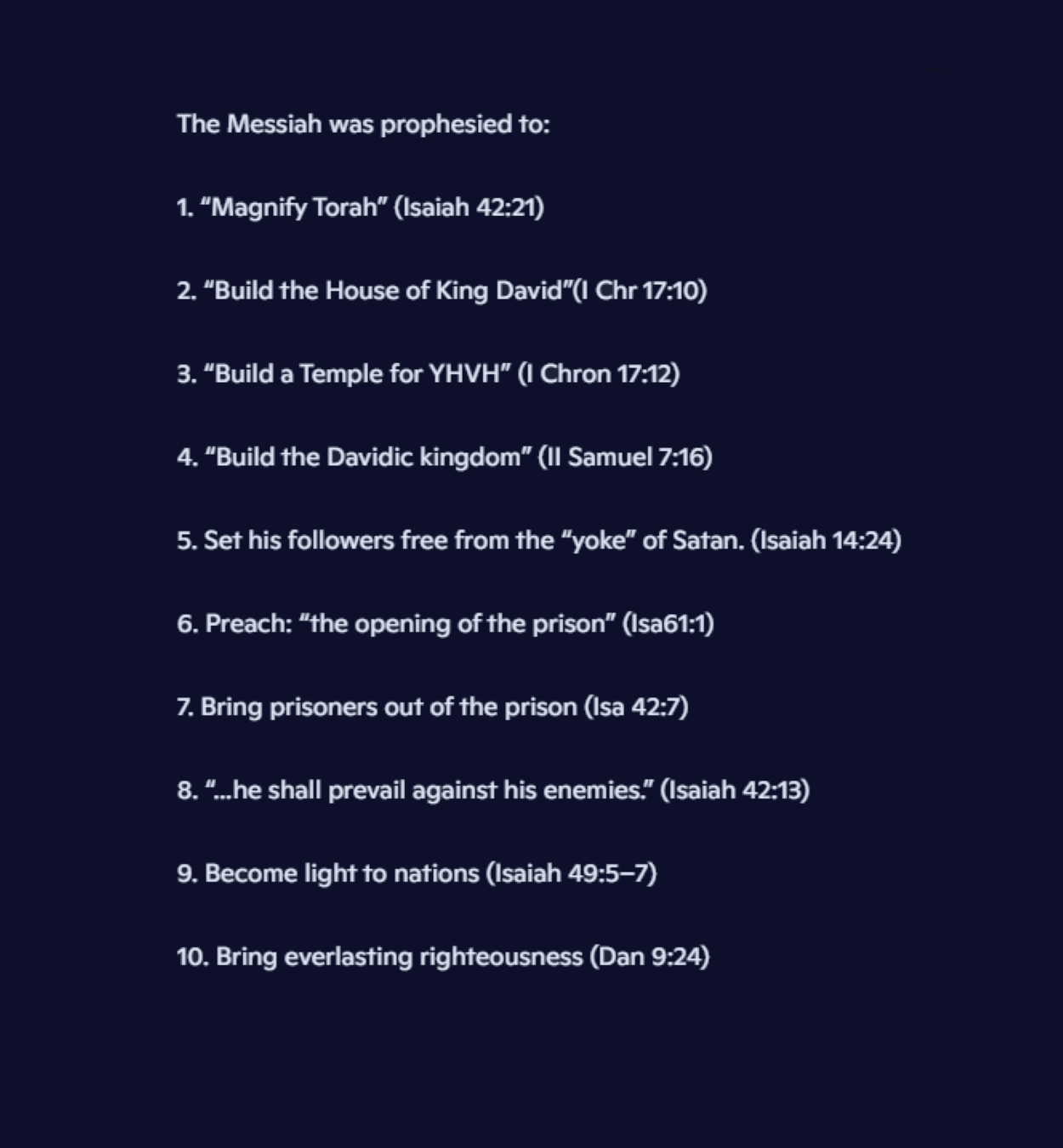
The Servant is commissioned to open prisons, free captives, and restore sight — jurisdictional liberation. (Isaiah 42:1-7)
The Servant becomes a light to the nations, extending YHVH’s jurisdiction beyond Israel. (Isaiah 49:6)
The Spirit‑anointed mission: liberty, release, recovery — the legal undoing of Satan’s claims. (Isaiah 61:1-2)
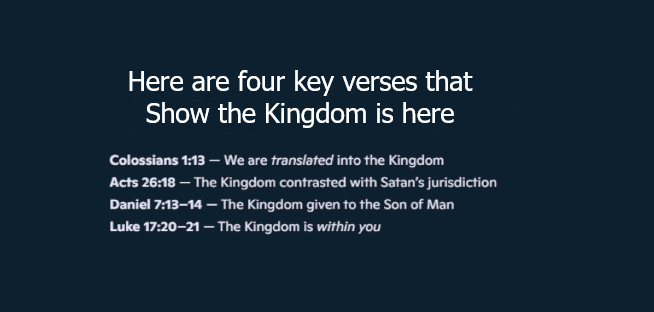
The Son of Man receives all jurisdictional authority from the Ancient of Days — the legal transfer. (Daniel 7:13-14)
Messiah declares the mission complete: “All authority in heaven and earth has been given to Me.” (Matthew 28:18)
Messiah purchases humanity from every nation and restores them — jurisdiction fully reclaimed. (Revelation 5:9)
Adam receives jurisdictional authority over the earth — the authority later lost to Satan. (Genesis 1:26-28)
The first prophecy of jurisdictional recovery through the Seed who will crush the serpent’s head. (Genesis 3:15)
Humanity’s original delegated dominion is affirmed — setting the stage for its restoration. (Psalm 8:4-6)
YHVH’s sworn promise to David: a biological descendant will rule forever — the legal basis for Messiah’s kingship. (I Chron 17:10-15)
Paul’s commission: to turn Gentiles from Satan’s jurisdiction to YHVH’s jurisdiction. (Acts 26:18)
Believers are transferred out of the jurisdiction of darkness into the Kingdom of the Son. (Col 1:13)
Messiah hands the Jurisdictional Authority back to YHVH, completing the reversal of Adam’s failure. (I Cor 15:24-28)
Reject all of the doctrines and practices created by Ignatius of Antioch, and everyone who came after him. Return to what Paul taught. (II Timothy 2:2) We reject all doctrines and practices created by Ignatius of Antioch and by every theological system that followed him, because they departed from the message and pattern Paul entrusted to faithful men (II Timothy 2:2). Our call is to return to what Paul taught — “The Way” — the original Kingdom movement established by the Holy Spirit in Acts 2.
We Reject Lent, Easter, Sunday Church traditions, and Christmas because these practices were created after the time of the Apostles—introduced through Ignatius of Antioch and the post‑Apostolic church system—and are not part of the faith once delivered to the saints. Our call is to return to what Paul taught (2 Timothy 2:2), not to the later traditions, festivals, or liturgical inventions of the institutional church.
Hebrew Language & Logic — Required Foundations for Bible Students The Hebrew language does not lend itself to Greek‑style philosophy. Hebrew communicates through concrete imagery, not abstract metaphysics. Where Greek uses intangibles, Hebrew uses physical expressions — for example, instead of saying “God is upset,” Hebrew says: “SMOKE IN MY NOSE.” This concrete, image‑based way of thinking forms the foundation of Jewish Block Logic, which presents truth in large, interconnected units — not in the linear, step‑by‑step reasoning of Greek Step Logic. Understanding Hebrew imagery and Block Logic is essential for becoming a better student of the Bible.
Never try to understand the New Testament by looking forward into our modern life; we must always go back into the Old Testament to discover the meaning of New Testament verses. The apostles wrote within the world of the Tanakh, not later Christian theology. Every New Testament statement is anchored in an earlier revelation. Examples: John 7:37–38 can only be understood by connecting it to Amos 8:11–12. Matthew 28:18 must be connected to Daniel 7:13–14. Acts 1:6 must be connected to Daniel 7:27. This is the only way to recover the original apostolic meaning and avoid the distortions created by later traditions and Replacement Theology.
The Jurisdictional Paradigm appears openly in Luke 1:74–75, where YHVH declares that His people will be delivered from their enemies so they may serve Him without fear, in holiness and righteousness. This is not poetry — it is jurisdictional language. Luke 1:74–75 reveals:
Deliverance from hostile jurisdiction (“from the hand of our enemies”)
Transfer into YHVH’s jurisdiction (“serve Him without fear”)
A new legal standing (“in holiness and righteousness”)
A restored relationship (“before Him all our days”)
This same jurisdictional pattern appears throughout Scripture: Daniel 7:13–14 — the Son of Man receives all authority
Daniel 7:27 — the saints receive the Kingdom
Acts 26:18 — Gentiles are transferred from Satan’s jurisdiction to YHVH
Colossians 1:13 — believers are moved from darkness into the Kingdom of the Son
Revelation 5:9–10 — Messiah purchases people from every nation and makes them a kingdom
Luke 1:74–75 is the earliest New Testament declaration of the Jurisdictional Paradigm — the legal transfer of authority from the enemy back to YHVH through Messiah.
Paul Is the Shaliach of Messiah for the Gentiles. Paul is the divinely appointed shaliach (authorized agent) of the Jewish Messiah for the Gentiles; therefore, the commandments of Messiah (John 14:15) come to the Gentile believer through Paul, not through the Four Gospels, Torah, or the Prophets. Messiah speaks to Israel through the Twelve, but He speaks to the Gentiles through Paul alone (Galatians 1:11–12; Ephesians 3:1–9; 1 Corinthians 11:1). This is the jurisdictional structure established by YHVH and confirmed by the Holy Spirit. Deuteronomy 18:18 establishes the pattern of YHVH raising up a human shaliach to speak His words with full authority. Messiah fulfills this for Israel — and then, by His own command and revelation, transfers that same shaliach authority to Paul for the Gentile believers. Paul does not preach about Messiah; he speaks for Messiah (Galatians 1:11–12). Thus, the Deut 18:18 chain of authorized representation flows: YHVH → Messiah → Paul → the Gentile assemblies. This is why the commandments of Messiah for Gentiles come through Paul, not through the Four Gospels, Torah, or the Prophets.
Messiah rejected the man‑made add‑ons, traditions, and rulings He faced during His earthly life — but He never condemned the Torah itself. The conflicts in the Gospels are always with human additions, not with YHVH’s commandments. Replacement Theology seizes these moments to “proof‑text” their claims, twisting Messiah’s rejection of traditions of men into an attack on the Torah. This is false. Messiah upheld Torah, exposed human additions, and fulfilled His mission as the Last Adam — not as the founder of a new religion.
YHVH will never do anything He has not already revealed through His prophets (Amos 3:7). This is the unbreakable rule of divine revelation. Every act of God in the New Testament must have its roots, patterns, and predictions in the Old Testament. Because Christianity as a religion — with its creeds, sacraments, hierarchy, liturgical calendar, and philosophical doctrines — is not found anywhere in the Old Testament, it cannot be the continuation of the faith of Abraham, Moses, David, or the prophets. This is why we identify institutional Christianity as “Mystery Babylon” — a man‑made religious system with no prophetic foundation in the Scriptures of Israel. If it is not in the prophets, it is not from YHVH.