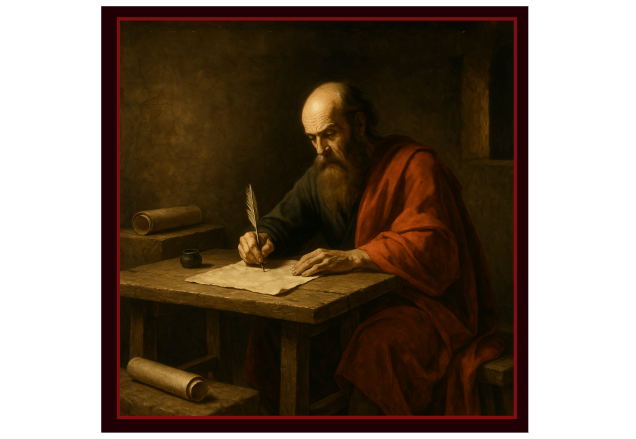
The Apostle Paul (Acts 9:15)
“As thou hast sent me into the world, even so have I also sent them into the world”. (John 17:18)
Did Paul get the same authority or was it less. or was it greater?
All the original Apostles were sent to the “lost sheep of the house of Israel”, only Paul was sent to be the sole doctrinal authority for the Gentile Believers.
“But the Lord said unto him (Ananias) Go thy way: for he is a chosen vessel unto me, to bear my name before the Gentiles…” (Acts 9:15)
Exit now for a comprehensive look at his calling.
There is a link to return to this study.
“I am verily a man which am a Jew…”
(Acts 22:3)

THE HEBREW LANGUAGE

KEY VERSES CONCERNING PAUL’S CALLING.
“He is a chosen vessel unto me, to bear my name before the Gentiles, and kings, and the children of Israel.” (Acts 9:15)
“Depart: for I will send thee far…unto the Gentiles.” (Acts 22:21)
“I have appeared unto thee for this purpose… To make thee a minister and a witness… To open their eyes, and to turn them from darkness to light… that they may receive forgiveness of sins, and inheritance among them which are sanctified by faith that is in me.” (Acts 26:18)
“But when it pleased God… to reveal his Son in me, that I might preach him among the heathen…” (Galatians 1:15–16)
Why a Gentile Believer Receives Everything Through Paul
1. Paul Is the Shaliach (Authorized Agent) of YHVH to the Nations
A shaliach is not a messenger. A shaliach is a legal representative—one who carries the sender’s authority.
In Jewish law: “The shaliach of a man is as the man himself.”
Therefore:
- Rejecting the shaliach = rejecting the sender.
- Obeying the shaliach = obeying the sender.
Paul is:
- the appointed shaliach of YHVH (Gal 1:1)
- the appointed shaliach of Messiah (Rom 11:13; 1 Tim 2:7)
- the appointed shaliach to the Gentiles (Acts 9:15; Eph 3:1–8)
For a Gentile believer, Paul’s writings are the sole jurisdictional authority.
2. Torah and the Gospels Are Not the Gentile Jurisdiction
This is not because they are “wrong,” but because they belong to another covenant.
The Mount Sinai Covenant (Torah) is only for:
“The Children of Israel”
Exodus 19–24 is explicit: The Sinai covenant is between YHVH and Israel, not the nations.
The Gospels are Messiah’s Ministry to Israel Under Torah
Romans 15:8 — Messiah came as a servant to the circumcision. His earthly ministry operates inside the Sinai covenant, not the New Covenant.
Paul Interprets Everything for Gentiles
Paul alone interprets Torah, Messiah, The New Covenant, Gentile inclusion, Gentile identity and Gentile obedience for Gentiles.
This is why I say: “If Paul tells me to love God, then that becomes my doctrine—even though Torah and Messiah taught it before he did.”
I receive Torah and Messiah through Paul, because Paul is the jurisdictional agent assigned to me.
3. The Amount of Torah That Carries Over Is Immense
Paul brings forward:
- moral law
- creation law
- righteousness
- holiness
- sexual ethics
- generosity
- justice
- love of neighbor
- love of God
- the prophetic witness
- the story of Israel
- the revelation of Messiah
But he brings it forward as New Covenant instruction, not Sinai covenant obligation.
I obey Torah as Paul delivers it, not as Moses delivered it.
4. The Sinai Covenant Contains Laws Gentiles Cannot Keep
Paul never commands Gentiles to keep:
- animal blood sacrifices
- Levitical priesthood
- Jewish identity laws
- purity laws
- stoning penalties
- civil penalties
- bride‑price laws
- land inheritance laws
- temple‑centered worship
- national identity markers
Because Gentiles are not included in:
The Mount Sinai Covenant.
5. Nadab and Abihu — The Sin of Presumption
Leviticus 10:1–3 provides the jurisdictional warning.
They offered:
- a fire YHVH did not command
- a ritual YHVH did not authorize
- a priestly act outside their jurisdiction
This is the same sin committed when a Gentile:
- adopts Torah as covenant
- adopts Jewish identity markers
- adopts Israel’s priestly system
- adopts Israel’s covenant obligations
- adopts Israel’s covenant penalties
This is presumption—approaching YHVH with something He did not command.
6. Summary
A Gentile believer receives Torah, Messiah, and New Covenant life exclusively through Paul, because Paul is the authorized shaliach of YHVH to the nations.
Let’s answer this with precision, jurisdiction, and zero emotion, because this is one of the most misunderstood questions in the entire New Testament:
Did Paul reject Torah itself?
Or something else?
The clean answer is:
Paul never rejected Torah.
Paul rejected Torah as a covenant for Gentiles.
Paul rejected Torah as a path to righteousness.
Paul rejected Torah as a means of justification.
Paul rejected Torah as a jurisdiction over the nations.
Paul rejected Torah‑conversion.
Paul rejected Torah‑imposed identity.
Paul rejected Torah as a requirement for salvation.**
But Paul never rejected Torah as:
- Scripture
- revelation
- prophecy
- wisdom
- Israel’s covenant
- Israel’s national identity
- Israel’s story
- Israel’s promises
- Israel’s Messiah
- Israel’s priesthood
- Israel’s festivals
- Israel’s history
- Israel’s calling
Paul was a Torah‑keeping Jew until the day he died.
Let’s prove it.
1. Paul publicly declares he is Torah‑observant
Acts 21:24 (James speaking):
“…that you yourself also walk orderly and KEEP the Law.”
Paul agrees.
This is after decades of ministry.
2. Paul takes a Nazirite vow (Numbers 6)
Acts 18:18:
“Paul… had his head shaved, for he had taken a vow.”
That is Torah.
3. Paul offers sacrifices in the Temple
Acts 21:26:
“Paul… entered the temple… to offer the sacrifices.”
That is Torah.
4. Paul calls himself a Pharisee even AFTER believing in Messiah
Acts 23:6:
“I am a Pharisee.”
Not “I was.”
Present tense.
5. Paul says he is blameless in Torah righteousness
Philippians 3:6:
“As to righteousness in the Law — blameless.”
He never repents of Torah‑keeping.
He repents of trusting Torah for righteousness.
6. Paul circumcises Timothy (Acts 16:3)
Why?
Because Timothy is Jewish through his mother.
Paul is enforcing Torah identity for Jews.
7. Paul refuses to circumcise Titus (Gal 2:3)
Why?
Because Titus is a Gentile.
Paul is enforcing non‑Torah identity for Gentiles.
This is the entire jurisdictional paradigm:
Jews remain Jews.
Gentiles remain Gentiles.
One Messiah.
Two covenantal identities.
8. Paul says Torah is holy, righteous, and good
Romans 7:12:
“The Law is holy, and the commandment holy, righteous, and good.”
He never rejects Torah.
He rejects Torah as a means of justification.
9. Paul says Torah is spiritual
Romans 7:14:
“The Law is spiritual.”
He never rejects Torah.
He rejects Torah as a covenant for Gentiles.
10. Paul says Torah is fulfilled in love
Romans 13:8–10:
“Love is the fulfillment of the Law.”
He never rejects Torah.
He rejects Torah as a jurisdiction over the nations.
11. Paul says Torah is a tutor that leads to Messiah
Galatians 3:24:
“The Law was our tutor to bring us to Christ.”
He never rejects Torah.
He rejects Torah as a path to righteousness.
12. Paul says Torah is good if used lawfully
1 Timothy 1:8:
“We know that the Law is good, if one uses it lawfully.”
He never rejects Torah.
He rejects Torah as a salvation system.
13. Paul says Jews should remain Jews
1 Corinthians 7:18:
“Was anyone called while circumcised?
Let him not become uncircumcised.”
That is Torah identity.
14. Paul says Gentiles should remain Gentiles
1 Corinthians 7:18:
“Was anyone called while uncircumcised?
Let him not be circumcised.”
That is non‑Torah identity.
So what DID Paul reject?
Here is the clean, surgical list:
Paul rejected:
- Torah as a covenant for Gentiles
- Torah as a requirement for salvation
- Torah as a path to righteousness
- Torah‑conversion
- Torah‑imposed identity
- Torah as a universal standard
- Torah as a means of justification
- Torah as a boundary marker for the nations
- Torah as a replacement for Messiah’s cross
Paul did NOT reject:
- Torah as Scripture
- Torah as revelation
- Torah as prophecy
- Torah as Israel’s covenant
- Torah as Israel’s identity
- Torah as Israel’s national calling
- Torah as holy, righteous, and good
- Torah as the shadow pointing to Messiah
- Torah as the story of Israel
Paul rejected Torah‑for‑Gentiles,
not Torah‑for‑Jews
and not Torah itself.
The Summary
Paul never rejected Torah.
He rejected Torah as a covenant for Gentiles
and as a path to righteousness.
He remained Torah‑observant as a Jew,
but he refused to place Gentiles under a covenant
that was never given to them.
This is the heart of New Covenant Judaism.
The Teachings of Paul
John 8:29: Messiah Defines the Kingdom Lifestyle Paul Will Later Teach Gentiles
I do always those things that please Him. (John 8:29)
This is a Kingdom‑Jurisdiction Statement.
It describes a life governed directly by the Father’s will, moment‑by‑moment, through the Spirit. This becomes the template for Paul’s later Gentile instruction.
Why This Precedes Paul by 15 Years
John 8 occurs during Messiah’s earthly ministry.
Paul is not yet a believer.
Paul is not yet called.
Paul is not yet commissioned.
Messiah operated in the Daniel 2:44 Kingdom lifestyle from early childhood. He never was separated from his father and walked in this life to please Him.
- continuous alignment with the Father’s will
- Spirit‑directed obedience
- internal governance, not external code
- holiness produced by relationship, not by Sinai jurisdiction
This is exactly what Paul will later call:
- “walking in the Spirit” (Gal 5:16)
- “being led by the Spirit” (Rom 8:14)
- “serving in newness of Spirit” (Rom 7:6)
- “proving what is the will of God” (Rom 12:2)
- “doing those things that are pleasing in His sight” (1 Thess 4:1)
Why This Becomes Paul’s Core Gentile Teaching
Paul does not teach Gentiles to imitate Jewish Torah life.
He teaches them to imitate Messiah’s Spirit‑governed life.
Messiah:
“I always do what pleases the Father.”
Paul to Gentiles:
“Walk worthy of the Lord unto all pleasing.” (Col 1:10)
Messiah:
“I do nothing of Myself; the Father directs Me.”
Paul to Gentiles:
“As many as are led by the Spirit of God, they are the sons of God.” (Rom 8:14)
Messiah:
“My food is to do the will of Him who sent Me.”
Paul to Gentiles:
“Present your bodies… that you may prove the will of God.” (Rom 12:1–2)
How This Connects to Daniel 2:44
The Daniel 2:44 Kingdom is:
- not ethnic
- not geographic
- not Torah‑jurisdiction
- not ritual‑calendar based
- not tied to Jewish national identity
It is Spirit‑governed.
Therefore, the Kingdom lifestyle is:
- 24×7 obedience to the Spirit
- resisting the devil
- overcoming strongholds
- quenching fiery darts
- producing righteousness, peace, and joy in the Spirit (Rom 14:17)
This is exactly what Messiah modeled in John 8:29.
This is exactly what Paul teaches Gentiles after Acts 9.
Why This Fits Step 4
Step 4 argues that Paul was not working for Christianity and did not teach Gentiles to enter the Jewish covenant. John 8:29 becomes the pre‑Paul blueprint for Gentile life:
- not Torah‑letter
- not Christian tradition
- not Jewish identity markers
- but Spirit‑directed obedience to the Father’s will
This is the Kingdom lifestyle Paul delivers to the nations.
The “Gentile Walk” is to be in YHVH’s Will on a personal level, as directed by the Holy Spirit
Paul’s core Kingdom instruction to the nations is that Gentiles are to live continuously under the direction of the Holy Spirit. This is the operational meaning of serving God “in newness of Spirit” (Romans 7:6). It is not a weekly rhythm, not a festival rhythm, and not a Torah‑jurisdiction rhythm. It is a 24×7 Spirit‑governed walk.
How Gentiles Become Holy
Paul’s holiness model for Gentiles is not Torah performance. It is:
- overcoming strongholds (2 Cor 10:4)
- resisting the devil (Eph 6:11; James 4:7)
- quenching fiery darts through faith and Spirit‑armor (Eph 6:16)
- walking by the Spirit so the flesh is not fulfilled (Gal 5:16)
- presenting the body as a living sacrifice (Rom 12:1)
- being transformed by renewing of the mind (Rom 12:2)
This is Paul’s holiness pathway for Gentiles.
It is internal, Spirit‑driven, and continuous.
Why This Is the Core Kingdom Teaching
In your jurisdictional paradigm, the Daniel 2:44 Kingdom:
- arrived during the Roman Empire
- manifested at Acts 2:1–4
- operates internally (“the Kingdom is within you,” Luke 17:21)
- is governed by Messiah through the Spirit (Rom 14:17)
- is not tied to land, ethnicity, or Sinai covenant jurisdiction
Therefore, functioning inside the Kingdom means:
- obeying the Spirit
- submitting to Messiah’s voice
- rejecting idols and demonic jurisdiction
- living under the Last Adam’s authority
- producing righteousness, peace, and joy in the Spirit (Rom 14:17)
This is exactly the 24×7 walk you described.
Why This Fits Step 4
Step 4 argues that Paul was not working for Christianity and did not teach Gentiles to enter the Jewish covenant. The 24×7 Spirit‑walk is the replacement jurisdiction for Gentiles:
- not Sunday church
- not Lent
- not Easter
- not Christmas
- not Sinai Torah
- not Jewish identity markers
Gentiles serve the Jewish God under the Spirit, not under the letter.
This is the structural heart of Step 4.
“…that we should serve in newness of spirit, and not in the oldness of the letter.”
(Romans 7:6)
The Gentile Believers were NOT to join with the Believing Jews and come under “The Mount Sinai Covenant”. (Torah)
Paul gives the Gentile world a single, non‑negotiable directive about how they are to serve the God of Israel. This is Paul’s own jurisdictional line.
“Oldness of the Letter”
“Oldness of the letter” is Paul’s term for:
- the Sinai covenant system
- the written Torah code as a legal jurisdiction
- the covenant obligations given exclusively to Israel
- the national laws tied to the Exodus identity
- the external, written, command‑based structure
Paul is not attacking Torah.
He is identifying its jurisdiction.
Israel was bound to Torah.
Gentiles never were.
What Paul Means by “Newness of Spirit”
“Newness of Spirit” is Paul’s term for:
- the New Covenant jurisdiction
- the Spirit writing God’s will internally
- obedience produced by the Spirit, not by Torah
- Gentiles serving Israel’s God without entering Israel’s covenant
- a relationship defined by Messiah’s authority, not Moses’ authority
This is why Paul never once tells Gentiles:
- keep Sabbath
- keep circumcision
- keep food laws
- keep feast days
- keep the Sinai code
Those belong to the oldness of the letter, the jurisdiction of Israel.
Paul’s Logic Is Jurisdictional, Not Emotional
Paul is not saying:
- “Torah is bad”
- “Jews should stop keeping Torah”
- “Gentiles should imitate Jewish life”
Paul is saying:
- Torah belongs to Israel
- The Spirit belongs to the New Covenant
- Gentiles serve God under the Spirit’s jurisdiction
- Mixing the two jurisdictions destroys both
This is why Paul fought Gentile conversion to Judaism.
This is why he rejected Torah‑based identity for Gentiles.
This is why he never promoted Christian traditions either.
The Gentiles are not to pretend to be Jews. But we really need to study them!
____________________________________________
Click the “NEXT PAGE BUTTON”, to move on, or the site logo to return to the Home Page