For those seeking our Secular Neuroplastic Therapy Sessions, please exit using the link below:
https://truthquestbs.network/about/
Welcome to Our TruthQuest Ministry Page
The confusion in religion did not begin with the Bible — it began around 100 A.D. When the early Gentile bishops (later called “Church Fathers”) detached themselves from the Jewish Messiah and the Jewish God (YHVH), they built a new system to replace the original Kingdom movement of Acts 2.
They constructed a new interpretive framework now known as Replacement Theology — the claim that “God the Father sent God the Son to establish the True Church for Jews to convert into.” Their proof‑text was Matthew 16:18, interpreted as the creation of a new institution.
When the Reformers (Luther, Calvin, etc.) arrived, they rejected Rome’s exclusive claim to that verse, arguing instead that Peter’s confession was “the rock.” But they did not return to the Kingdom model of Acts 2 — they simply created the Reform Paradigm.
Later, another movement constructed the Dispensation Paradigm, adding yet another layer of interpretation.
Three post‑apostolic paradigms — all producing competing meanings — none of them used by Paul.
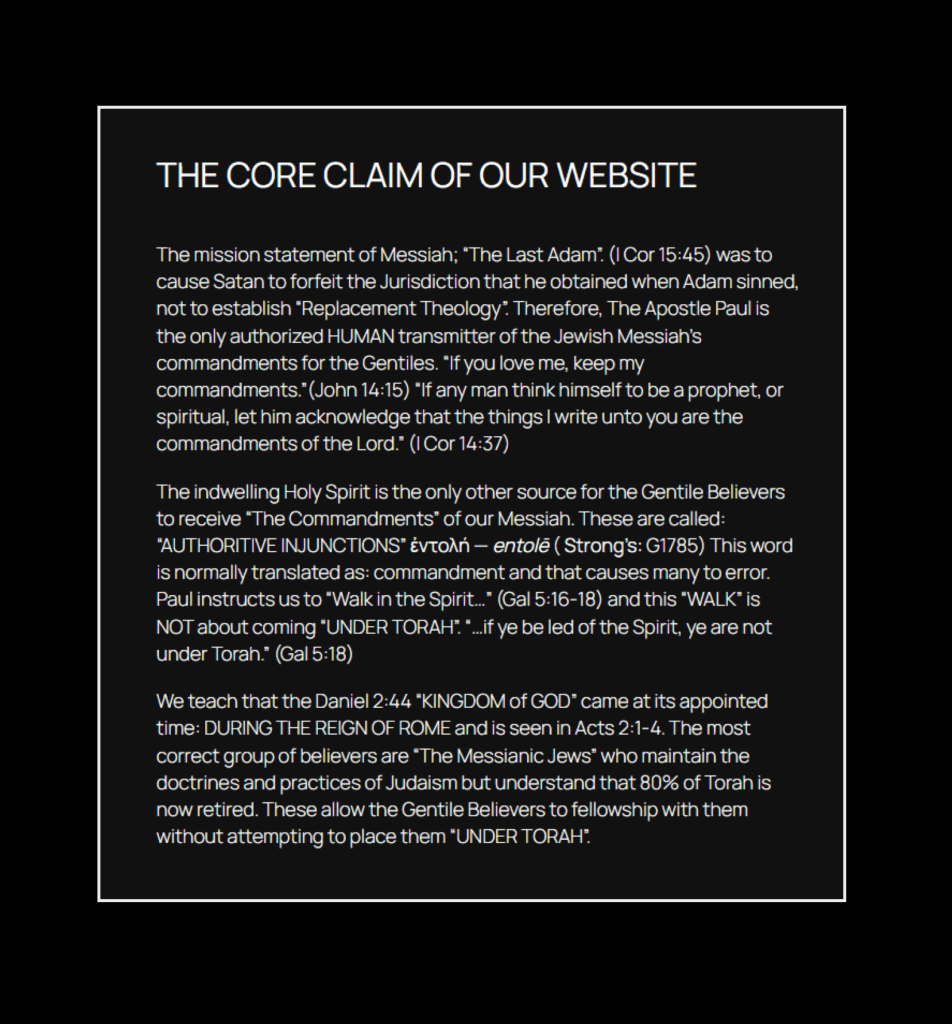
The original “Last Adam” paradigm was used by The Apostle Paul and is correct. (“Jurisdictional Paradigm”)
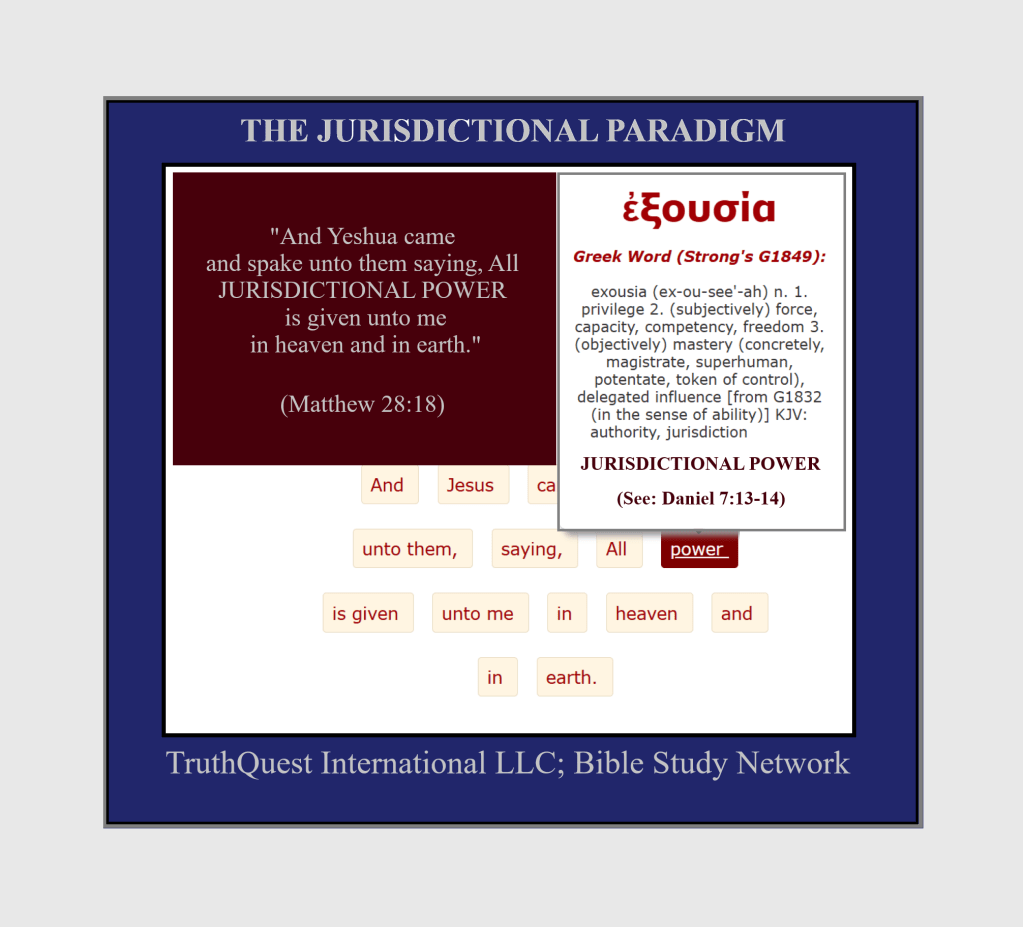
JURISDICTIONAL FRAMEWORK OVERVIEW
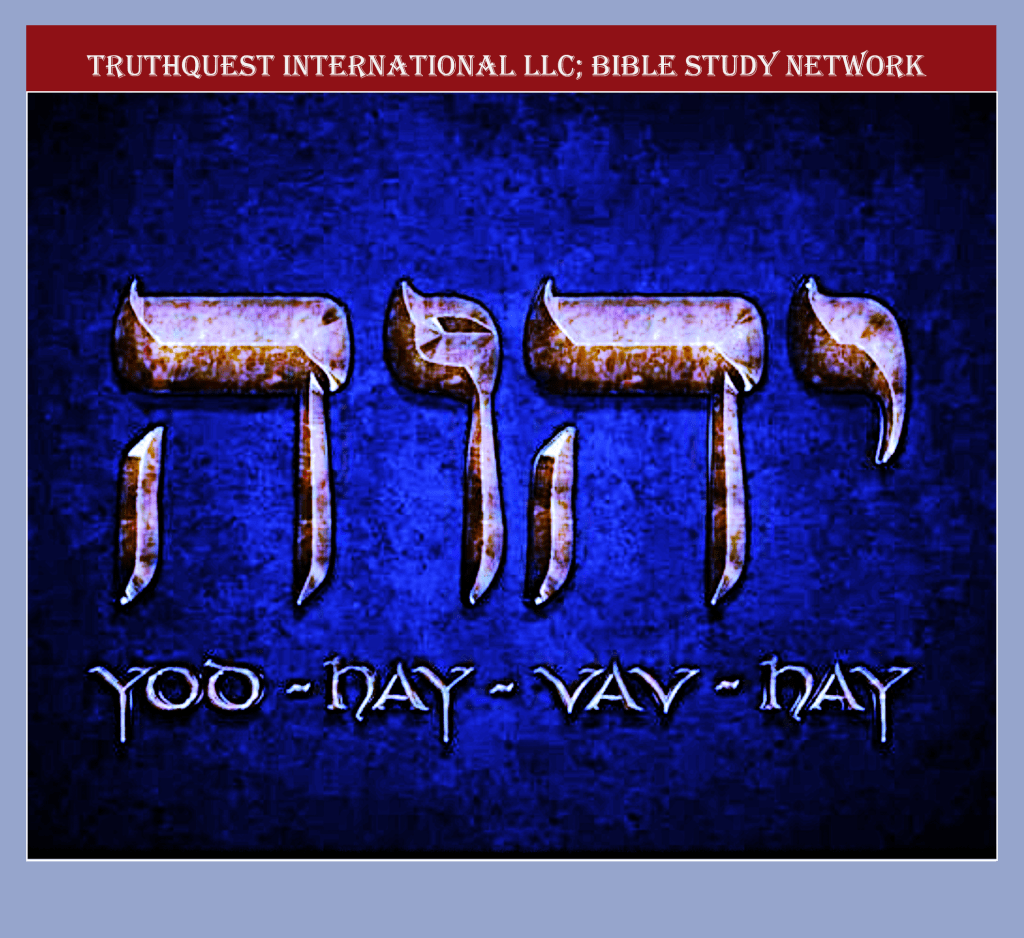
TruthQuest International LLC; Bible Study Network is your one‑stop resource for everything “True Believers” need to understand why most Believers today are trapped between two failed systems:
The Mount Sinai Covenant (Judaism) — which still rejects The Last Adam as a false prophet.
Replacement Theology (“The True Church”) — which rejects The Last Adam by replacing Him with a being they describe as “Fully God and Fully Man,” the founder of a Gentile religious institution that demands Jews abandon Torah.
Neither of these two paradigms will allow the Bible Student to understand the Daniel 2:44 “Kingdom”, the Isaiah 35:8 “Way of Holiness” and the Jeremiah 31:31-34 “New Covenant”.
Both systems obscure the original storyline revealed by the prophets, Messiah, and Paul.

Why Conflicting Paradigms Produce Confusion (1 Cor 14:33)
Confusion in doctrine does not arise from Scripture itself. It arises from competing interpretive paradigms. When students approach Paul with a framework he did not use, they inevitably produce conclusions he never taught. Paul operates inside a jurisdictional paradigm rooted in Adam, Messiah, authority transfer, and legal dominion. Most theological systems do not.
When a reader imports a foreign paradigm — covenantal, denominational, dispensational, restorationist, or institutional — Paul’s statements are reinterpreted through a lens he never authorized. This creates contradictions, doctrinal collisions, and theological instability. The problem is not the text; the problem is the lens.
Paul’s jurisdictional paradigm is consistent, legal, and unified. It explains:
- why Messiah is called the Last Adam
- why the cross is a jurisdictional overthrow
- why Paul receives commandments from the risen Messiah
- why Gentiles receive a non‑Torah, Spirit‑given command system
- why the ekklēsia is the restored house of David
- why Israel’s calling remains intact (Romans 11)
Every competing paradigm rearranges these elements, producing the confusion Paul warns against. God is not the author of confusion; competing paradigms are.
The Three Divisions Within Christianity
Christian interpretation of Israel, the covenants, and the Law divides broadly into three major paradigms.
Each system approaches Hebrews 8:13, Galatians 3, and Matthew 5 from a distinct theological framework and produces a different understanding of Israel’s identity, the continuity of Torah, and the nature of the New Covenant.
The Covenant Paradigm (Replacement / Supersession Systems)
Who teaches it:Who teaches it:
Augustinian and post‑Reformation covenant theologians, Roman Catholic Church, Mainline Reformed traditions and Presbyterian and many confessional Protestant bodies
Summary: This paradigm teaches that the Old Covenant ended and the Church replaces Israel as the covenant people. Israel’s national identity and prophetic future are absorbed into the Church. The promises to Israel are spiritualized and reassigned to the Christian community. Hebrews 8:13 is interpreted as the end of Israel’s covenantal existence.
The Dispensation Paradigm (Classical and Revised Dispensationalism)
Who teaches it:
Scofield, Chafer, Ryrie, Walvoord, Pentecost, and their successors
Summary:
This paradigm maintains a permanent distinction between Israel and the Church. The Sinai covenant ended, but Israel’s national promises remain future and will be fulfilled literally. The Church Age is viewed as a parenthesis in God’s plan for Israel. The New Covenant is applied primarily to Israel in the future, not to the Church in the present.
Dallas Theological Seminary
Moody Bible Institute
Many evangelical and fundamentalist churches
The Restoration Paradigm
(Messianic, Hebrew Roots, One‑Law, Two‑House, Torah‑Keeping Gentiles, “Self‑Converted Israel,” etc.)
Who teaches it:
Individuals who adopt Jewish identity markers or place themselves under Torah
Summary:
This paradigm teaches that the Sinai covenant continues in some form and that Torah observance is restored or extended to believers. Israel and the Church merge into a single covenant people. The Old Covenant is not viewed as terminated but as revived, expanded, or re‑applied. Covenant identity is often pursued through Torah‑keeping rather than through the New Covenant.
Messianic Judaism (various branches)
Hebrew Roots Movement
One‑Law and Torah‑for‑All groups
Two‑House / Ephraimite movements
Torah‑keeping Gentile fellowships
The Post‑70 A.D. Shift
After 70 A.D., Gentile Bishops detached themselves from the Jewish sect historically known as “The Way” .
(Acts 9:2; 19:9, 23; 24:14, 22)
They constructed a new religious system using:
- Greek Step Logic (Plato, Aristotle, Zeno, Epicurus)
- Pagan religious concepts from Babylon and Egypt
- Doctrines foreign to Hebrew Block Logic used by Moses, Jeremiah, Ezekiel, and Isaiah
This system produced the doctrines of the “True Church,” the Trinity formulas, and the idea of “God; the Son”—a phrase never found in the 66 books of the Jewish Scriptures.
TruthQuest rejects both this entire framework and the other where Gentiles become Torah compliant partakers of the Mount Sinai Covenant.
We are the followers of The Apostle Paul.
(He teaches the Gentiles the commandment of Messiah)
“Be ye followers of me, even as I also am of Christ.” (I Cor 11:1)
Why Replacement Theology Cannot Interpret Scripture
Replacement Theology’s central claim—that:
“God; the Father sent God; the Son
to convert
Torah‑keeping Jews to Christianity”—
(is Unscriptural)
.
This paradigm makes key prophecies meaningless, including:
“…then I restored that which I took not away”
(Psalm 69:4)
The verse makes no sense in their system.
The Central Truth Taught by TruthQuest
YHVH (Exodus 3:15) sent The Word of YHVH (John 1:1–18) to become the biological descendant of King David (1 Chron 17:10–15) and to unjustly die (1 Cor 2:8) so that:
Satan would lose the jurisdiction he obtained when Adam sinned.
- Matthew 4:8–10 — Satan claims jurisdiction
- Genesis 3 — Adam forfeits it
- Acts 26:18 — Messiah opens the eyes of the nations
- Colossians 1:13 — transfer of jurisdictional authority
Paul concludes:
If the rulers had understood the legal outcome, they would not have crucified Him. (1 Cor 2:8)
This is the foundation of the Jurisdictional Paradigm:
Satan lost his kingdom by killing a sinless human being—“The Last Adam.” (1 Cor 15:45)
The Purpose of YHVH (Isaiah 14:24–28)
This passage reveals the mystery of YHVH’s intent:
“As I have purposed, so shall it stand.”
This purpose is the key to understanding:
- (BREAK) “THE YOKE”
- (TAKE) “MY YOKE” (Matthew 11:28–30)
- “Proclaim liberty to the captives…” (Isaiah 61:1)
From this purpose flows the Jurisdictional Paradigm:
YHVH reclaims the jurisdiction Adam lost and transfers it to the Son of David, whose kingdom cannot be overthrown.
Paul: The Only Authorized Shaliach of the Jewish Messiah
TruthQuest teaches that Scripture must be interpreted:
- within the Hebrew context
- inside YHVH’s jurisdictional framework
- revealed by the prophets
- confirmed by Yeshua
- transmitted to the nations through Paul alone
Paul is the only Shaliach (Authorized Sent One) of the Jewish Messiah to the Gentiles.
The Messiah: One Nature, One Being
TruthQuest teaches:
- Yeshua is The Word of YHVH made flesh (John 1:1–18)
- He is not “Fully God and Fully Man” (a doctrine created in 451 A.D. at Chalcedon)
- He is one human being with one human nature
- His spirit is The Word of YHVH who released all divinity except memory (Phil 2:6)
- He now lives in a glorified human body (Phil 3:21)
- We will be like Him (1 John 3:2)
“The Church Fathers” could not understand this because they did not understand that a human is a spirit that lives in a physical body.
Our soul (G-5590 ψυχή psyche) is the seat of our logic, emotion and will.
Rejecting the Doctrines of Ignatius and the Church Fathers
Ignatius of Antioch is the founder of Replacement Theology.
His doctrines—and those of all who followed him—must be rejected.
When we return to YHVH’s purpose, the Scriptures become unified, coherent, and jurisdictional. The errors of the four major theological paradigms are exposed, and the original storyline is restored.
https://truthquestbs.network/13-steps-of-making-disciples/