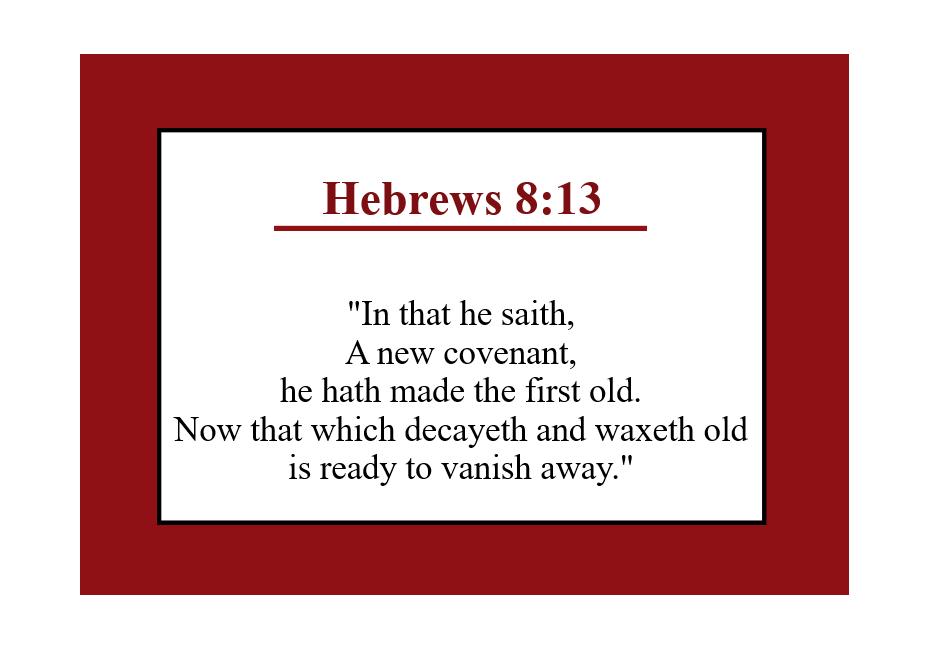
HEBREWS 8:13
Hebrews 8:13 is our introductory Bible Study in the Book of Hebrews.
We suggest reading that first and then select our other studies in Hebrews. We supply the links to our other studies in Hebrews at the end of this page!
Check out our “ORIENTATION” studies:
About the book
Hebrews was written for believing Jews, using their native block‑logic structure. Jewish block logic presents truths in large, interconnected conceptual units rather than in the linear, step‑by‑step progression familiar to Western readers.
Because of this, Hebrews can feel dense, circular, or overwhelming to those trained in Western step logic.
The difficulty is not in the text. The difficulty is in the paradigm of the reader.
Hebrews assumes:
a working knowledge of the Levitical priesthood
covenant structure and covenant failure
sanctuary patterns and typology
sacrificial logic
prophetic expectation
national history
legal categories of clean, unclean, holy, and profane
Without this background, the book feels like advanced material because it is advanced material.

Select from the links on the right:
(Or return to our home page by clicking) https://truthquestbs.network/
Hebrews
E.
Hebrews
F.
Hebrews
G.
Hebrews
H.
Frequently Asked Questions
What should the newer Bible Student study first?
For those relatively new to Bible study, it is wise to build a jurisdictional foundation before attempting Hebrews. The following order establishes Paul’s framework first, so Hebrews becomes clear rather than confusing: Romans, Ephesians, Galatians, Colossians, I & II Timothy, I & II Thessalonians, Acts.
Why read Hebrews last?
This sequence grounds the student in Paul’s jurisdictional paradigm — Adam, Messiah, authority transfer, covenant transition, and Spirit‑given commands for the nations — so that when they finally reach Hebrews, the structure is no longer foreign.
Can you give a summary?
Hebrews is not difficult because it is obscure. It is difficult because it speaks in Jewish covenant logic, not Western academic logic. Once Paul’s “Jurisdictional Paradigm” is in place, Hebrews becomes one of the clearest books in the New Testament.
What are the other “Paradigms” different readers use?
The Jewish Paradigm, The Replacement Theology Paradigm, The Dispensational Paradigm & The Restoration Paradigm are the main ones.
 TruthQuest International LLC; Bible Study Network