The Four-Consonant Name of:
“YHVH”
The most sacred designation for the God of Israel is called the Tetragrammaton — a Greek term meaning “the four letters.”
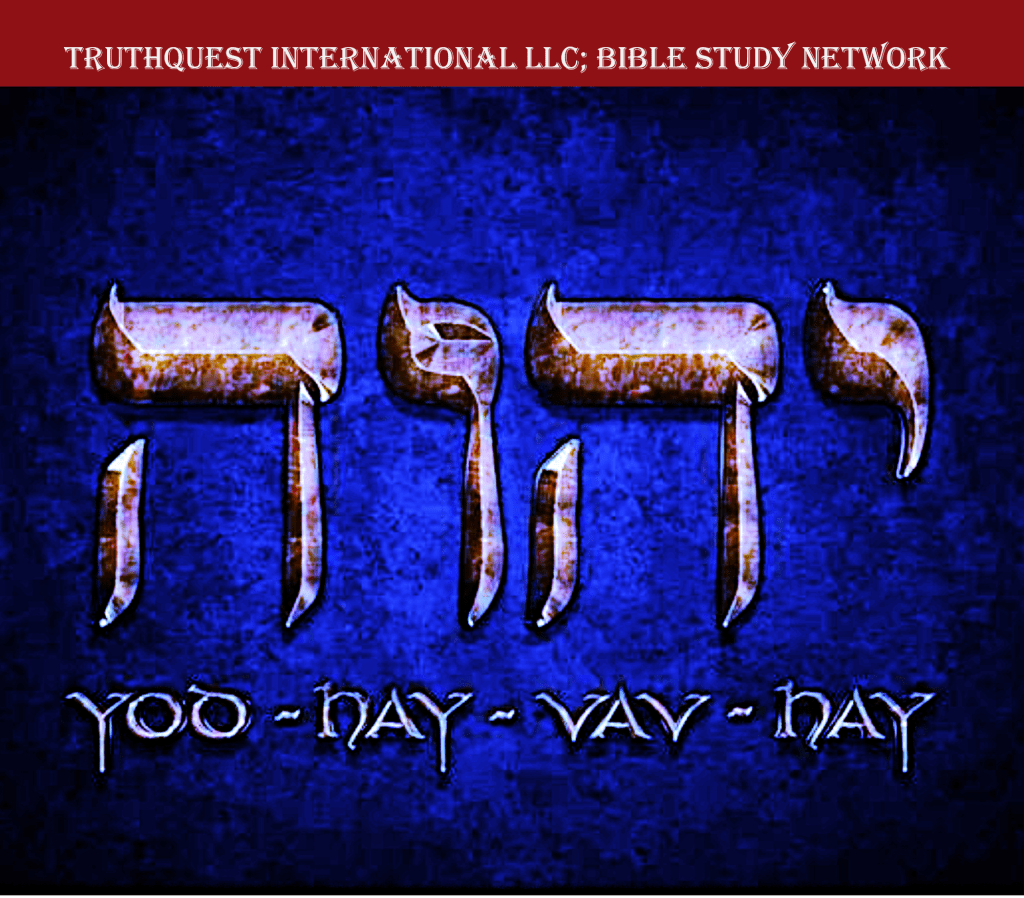
These four Hebrew consonants are:
Yod – He – Vav – He
(יהוה)
(Which are read from right to left)
This is the name revealed to Moses and used throughout the Hebrew Scriptures. Because it is the personal name of the Creator, it was never intended to be spoken casually, carelessly, or as a common title.
What the Tetragrammaton Is — and isn’t.
- It is not a generic word for “God.”
- It is not a title like “Lord,” “Master,” or “Judge.”
- It is the proper name of the One who declared His eternal purpose in Isaiah 14:24.
The Tetragrammaton identifies who He is in covenant, not merely what He is in power. Tetragrammaton identifies who He is in covenant, not merely what He is in power.
Why the Four Letters Matter
The four consonants carry the idea of being, existence, and self‑sustaining life.
They point to the One who: Was before creation Is sovereign over all nations Will be the One who fulfills His declared purpose.
This is why the prophets anchor their authority in the phrase:
“Thus says YHVH.”
They are not speaking for a religion — they are speaking for the One whose purpose cannot fail.
Why the Name Is Not Pronounced
Over time, Israel adopted the practice of not vocalizing the name aloud except in the Temple by the High Priest. This was done to avoid making “HIS NAME” common.
Substituting human familiarity for divine authority
As a result, the exact ancient pronunciation is not preserved.
Modern substitutes (such as “Jehovah” or “Yahweh”) are reconstructions, not certainties. The most likely pronunciation would be “YAH”-“VEH” (The sound of one inhale & one exhale)
Our site’s position — that the name should not be spoken casually — aligns with this ancient reverence.
How Scripture Handles the Name
Because the name was not spoken aloud, Jewish tradition replaced it with titles such as:
Elohim — the title “God”
Your Jurisdictional Paradigm depends on this distinction, because jurisdiction flows from the One who names Himself, not from human religious systems.
Adonai (“Lord”)
HaShem (The Name)
Why the Tetragrammaton Matters
The Tetragrammaton is the anchor of the entire Jurisdictional Paradigm:
Revelation shows the final restoration under His name
Everything begins with the One who says:
“As I have purposed, so shall it stand.”
The four letters identify the One whose purpose governs all Scripture.
Isaiah 14:24 reveals His declared purpose
Daniel 7 shows His transfer of jurisdiction
Paul explains how Messiah fulfills that purpose
Click on either image to return to Homepage.
 TruthQuest International LLC; Bible Study Network