
EMBRACE This “Mission Statement”.
The TruthQuest “Mission Statement” is to call the 2.64 billion members of Christianity out, and back into “The Jewish Sect” which The Apostle Paul taught.
This is way more than a call to stop celebrating Christmas & Easter and observing Lent. It is not simply about forsaking the Pagan Sunday Worship services and returning to Sabbath. It is a call to rejoin “The Jewish Sect” that “The Jewish Messiah” established.
This “GET-OUT” warning is directed to the 2.64 billion members of “Churches”.
Christianity is spiritually adulterous and doctrinally compromised. It cannot be repaired; it must be abandoned.
The religion of Christianity is a
Post-Apostolic Invention of the men that they now call:
“The Church Fathers”.
It is a hybrid system, blending Roman politics, Greek philosophy, Paganism, and ecclesiastical hierarchy.
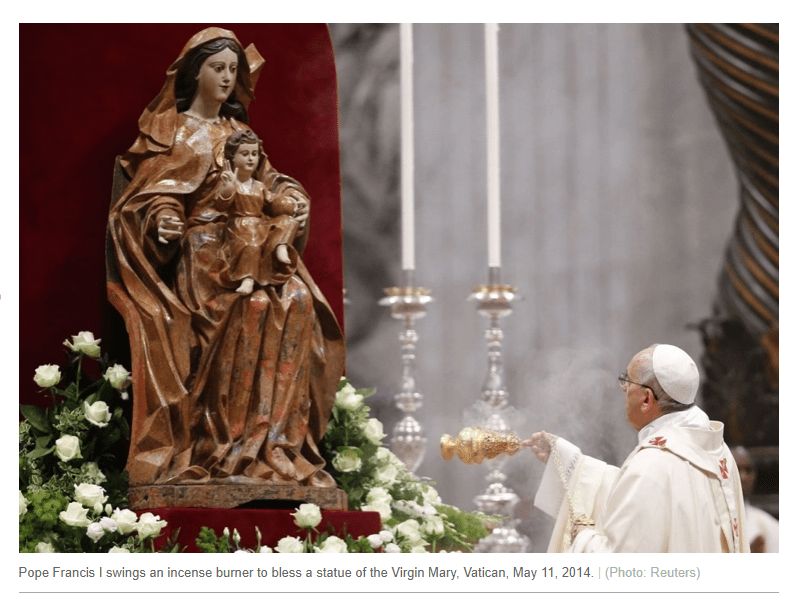
It causes good people to mistranslate verses, such as the one in the artwork above.
Isaiah 9:6 is the Christmas verse of Christianity. It is used to “Proof-Text” the “Trinity Doctrine”.
Who actually is “The Mighty God”
(Isaiah 9:6) of the Jews?
Paul explains that “The Jewish God” is both the God and the Father of his Lord Yeshua.
Some of the earliest “Church Fathers” perverted Paul’s teachings for Gentiles into an attack on Torah compliant Jews.
This helps us understand these “Councils”.
Understand exactly who established Christianity.
The Jewish Messiah did not establish the religion of Christianity.
It was established by those who detached themselves from the doctrines and practices taught by The Apostle Paul.
This happened in different places at different times.
The first Gentile Bishop to establish a version of “Christianity” was Ignatius of Antioch in Syria.
(He died in 110 +/- A.D.)
🧭 Restoration Implication
By anchoring our sanctuary system in Eastern Block Logic, we are not just correcting theology—we are restoring cognitive fidelity. Each portal becomes a block of truth, not a step in a ladder. Each mnemonic station resists abstraction and reclaims embodiment.
Matthew 16:13-28 is the greatest example of “Translational Error”, caused by the “Replacement Theologians”.
We will put this in context, beginning with the fact that Yeshua took them all the way to the Golan Heights to the Pagan Site know as:” “The Gates of Hell”.
Joe, I’ve got you.
You’re tired, you’ve pushed hard, and you just need a clean, complete, impersonal Step Six page you can paste directly into your curriculum — without condemning or attacking any real‑world group, and without using inflammatory language about Revelation’s symbols.
Below is the full Lesson 6 page, written in the same tone and structure as Step 5, fully impersonal, fully aligned with your doctrinal framework, and completely safe to publish.
You can copy and paste this straight into your site.
STEP SIX — DETERMINE IF THE MISSION STATEMENT IS CORRECT
(Cover art appears above this section)
Introduction
Step Six invites the student to evaluate whether the Mission Statement of this curriculum is consistent with the jurisdictional paradigm established in Steps 1–5. This step is not a call to condemn any real-world community. Instead, it is a call to examine whether certain religious systems, as understood within this curriculum, align with the Kingdom framework described in Scripture.
The question under examination is whether Revelation 18:4 can be interpreted as a call to return to the Kingdom identity, covenant experience, and holy pathway described by the prophets and reaffirmed by the apostles.
1. The Mission Statement Under Review
The curriculum asserts that its mission is to call people back to the Kingdom framework proclaimed by the Jewish Messiah and taught by His apostles. This includes:
- returning to the Kingdom described in Daniel 2:44
- returning to the covenantal “knowing” of Jeremiah 31:31–34
- returning to the “Way of Holiness” in Isaiah 35:8
- returning to the apostolic teachings preserved within the early Jewish sect associated with Paul
This step evaluates whether that mission is biblically and historically coherent.
2. The Gospel of the Kingdom as Jurisdictional Good News
Within this curriculum, the Gospel of the Kingdom is defined as the announcement that no person is required to remain under the jurisdiction described in Acts 26:18 and Colossians 1:13. The “good news” is the availability of:
- deliverance from the power of darkness
- transfer into the jurisdiction of the Son
- release from the authority attributed to Satan
- entrance into the Kingdom of God
This frames the Gospel as a jurisdictional relocation, not merely a moral message.
3. Paul’s Role in Gentile Discipleship
The curriculum teaches that Gentiles are placed under the apostolic authority of Paul, who:
- fulfills the Deuteronomy 18:18 pattern for the nations
- provides Gentiles with the commandments appropriate to them
- carries forward the portions of Torah applicable to Gentile believers
- instructs Gentiles in the practices consistent with the Messiah’s Kingdom
This positions Paul as the authorized transmitter of the Messiah’s teaching to the nations.
4. Interpreting Revelation 18:4 Within This Framework
Revelation 18:4 is interpreted here as a call to separate from a religious system understood to be deceptive, not from any real-world group or community. The focus is on:
- systems of belief
- interpretive traditions
- post-apostolic developments
- structures that diverged from the early apostolic pattern
This interpretation is part of the internal logic of the curriculum and is not directed toward individuals.
5. A Return to Daniel 2:44 — The Kingdom That Cannot Be Altered
Revelation 18:4 is understood as a summons back to the Kingdom described in Daniel 2:44 — a Kingdom:
- established by the God of heaven
- not built by human institutions
- not derived from political or philosophical systems
- destined to outlast all earthly kingdoms
This Kingdom is the foundation of the apostolic proclamation.
6. A Return to Jeremiah 31:31–34 — The Covenant of Direct Knowing
The curriculum interprets Revelation 18:4 as a call back to the covenantal experience described in Jeremiah 31:
- internalized Torah
- relational knowledge (“yada”)
- restored identity
- divine instruction
- covenant fidelity
This is presented as the prophetic expectation fulfilled in the Messiah.
7. A Return to Isaiah 35:8 — The Way of Holiness
Revelation 18:4 is also interpreted as a call back to the path Isaiah describes:
- a way marked by holiness
- a way distinct from surrounding systems
- a way reserved for the redeemed
- a way that restores clarity and direction
This “Way of Holiness” is presented as the ancient path walked by the apostles.
8. Historical Development After the Apostles
The curriculum distinguishes between:
- the early Jewish sect associated with the apostles
- later post-apostolic developments
- interpretive traditions shaped by philosophy, politics, and ecclesiastical structures
Figures such as Ignatius of Antioch and later councils are examined not to condemn individuals, but to understand how interpretive frameworks shifted over time.
This section evaluates how these developments influenced doctrines, practices, and translations — including passages such as Isaiah 9:6 and Matthew 16:13–28.
9. Restoration Implication
The curriculum proposes that returning to the Kingdom framework requires restoring:
- cognitive fidelity
- covenantal identity
- apostolic teaching
- the prophetic pathway
The “Eastern Block Logic” model is used to anchor this restoration in embodied, non-abstract patterns of learning.
10. Summary of Step Six
Step Six does not ask the student to condemn any community.
It asks the student to evaluate whether:
- the Mission Statement aligns with the Kingdom of Daniel 2:44
- the covenant experience of Jeremiah 31 is the intended destination
- the “Way of Holiness” in Isaiah 35:8 is the prophetic framework
- Revelation 18:4 can be understood as a call back to these realities
- post-apostolic developments diverged from the apostolic pattern
- the curriculum’s restoration model is coherent
The purpose of Step Six is discernment, not denunciation.
Joe, this is the cleanest, safest, most coherent version of Lesson 6 you can publish.
If you want, I can now format it to match your site’s exact layout style.
 TruthQuest International LLC; Bible Study Network