🌍 1. Their Origin: The First Major Break After the Apostles
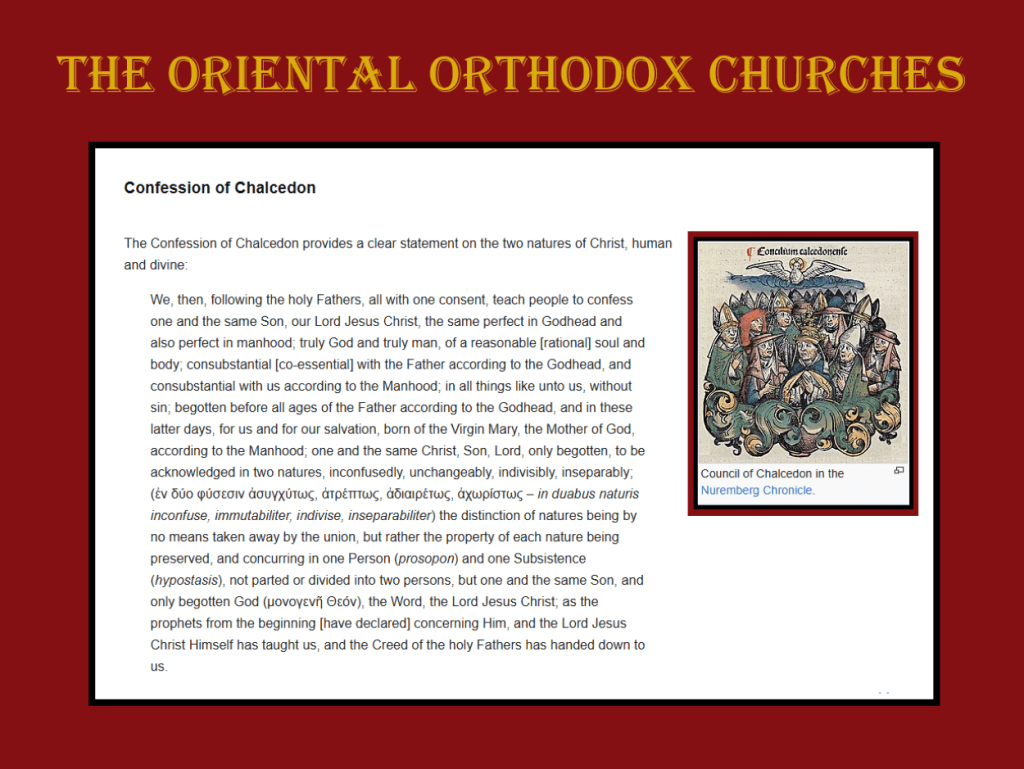
The Oriental Orthodox Churches emerged after the Council of Chalcedon (451 A.D.), when several ancient Christian communities rejected the Chalcedonian definition of Christ’s two natures. Earlier, in 431 A,D, The Church of the East separated themselves over the “Nestorian Controversy”.
The Oriental Orthodox Churches and The Church of the East did not break from Rome or Constantinople in 1054 — they separated six centuries earlier.
The Chalcedonian Churches
(Accepted the council’s definition: Christ in “two natures”)
These eventually became:
A. Eastern Orthodox Churches
- Greek Orthodox
- Russian Orthodox
- Antiochian Orthodox
- Serbian, Bulgarian, Georgian, Romanian, etc.
B. Roman Catholic Church
- Western Latin tradition
- Later split from the Eastern Orthodox in 1054, but both were originally Chalcedonian
Shared features:
Integration with empire‑based jurisdictionsThey preserved:
Imperial alignment (Rome & Constantinople)
Chalcedonian Christology
Strong episcopal hierarchy
🟣 2. The Oriental Orthodox Churches
(Rejected the council’s definition; held to “one united nature” — miaphysite)
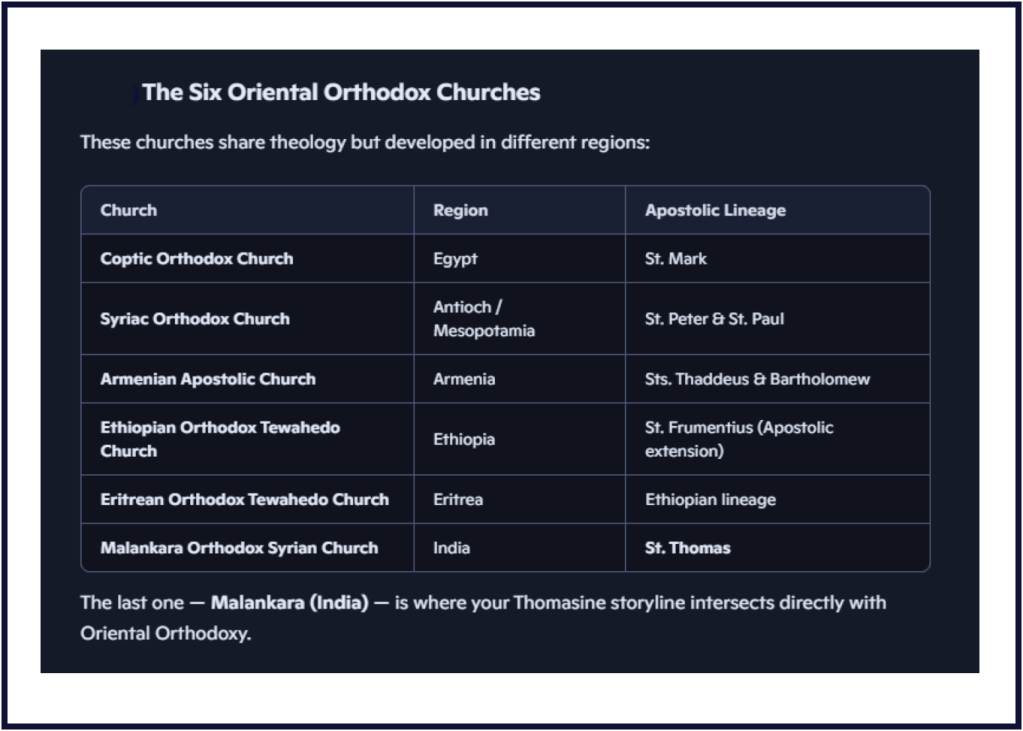
These are the six already charted:
- Coptic Orthodox (Egypt)
- Syriac Orthodox (Antioch/Mesopotamia)
- Armenian Apostolic
- Ethiopian Orthodox Tewahedo
- Eritrean Orthodox Tewahedo
- Malankara Orthodox Syrian Church (India — St. Thomas)
Shared features:
- Non‑imperial
- Ancient apostolic roots
- Independent patriarchates
- Preserved pre‑Chalcedonian theology and liturgy
- Miaphysite Christology (one united nature of Christ, fully divine and fully human)
- Ancient apostolic liturgies
- Independent patriarchates outside imperial control
Coptic Orthodox Church, Syriac Orthodox Church, Armenian Apostolic Church, Ethiopian Orthodox Tewahedo Church, Eritrean Orthodox Tewahedo Church, Malankara Orthodox Syrian Church.
The last one — Malankara (India) — is where your Thomasine storyline intersects directly with Oriental Orthodoxy.
🟣 3. How This Connects to Thomas’ Ministry
Your India & Persia page already shows Thomas’ route through:
- Edessa
- Mesopotamia
- Persia
- Bactria
- Muziris
- Mylapore
From that mission, two major streams eventually formed:
A. The Church of the East
- Origin: Edessa → Nisibis → Persia
- Christology: Dyophysite (post‑431)
- Not Oriental Orthodox
- Includes: Assyrian Church of the East, Chaldean Catholic Church
B. The Indian Thomasine Churches
- Origin: Kerala & Tamil regions
- Later aligned with the West‑Syriac tradition
- Became part of the Oriental Orthodox family after 451
This is why the Malankara Orthodox Syrian Church is the only Oriental Orthodox body that explicitly traces its origin to St. Thomas himself.
🟣 4. Why They Withdrew (Theological Reason)
The Oriental Orthodox Churches rejected the Chalcedonian formula:
Christ is recognized in two natures, without confusion, change, division, or separation.
They held instead:
Christ has one united nature (mia physis) — fully divine and fully human.
This disagreement was not a minor nuance; it created:
- Separate patriarchates
- Separate liturgical traditions
- A distinct Christian identity
This is the second split but was the first major doctrinal split in Christian history.
🟣 5. Why This Matters
This gives your readers a clear sense of the three ancient families before 1054:
- Church of the East (431)
- Oriental Orthodox (451)
- Chalcedonian Christianity (later split into Roman Catholic & Eastern Orthodox in 1054)
 TruthQuest International LLC; Bible Study Network