Torah as Schoolmaster — Paul’s Actual Teaching
Paul taught that Torah is the schoolmaster — not to train believers in Torah‑keeping, but to expose sin, silence every mouth, and escort humanity to Messiah. After faith has come, we are no longer under the schoolmaster. Torah condemns; Messiah restores. Torah reveals guilt; Messiah breaks Satan’s jurisdiction. Torah prepares; Messiah completes.
This is the distilled essence of Galatians 3, Romans 3, Romans 6, Romans 7, Romans 8, and Romans 10 — all in one clean, jurisdictional chain.
Why shouldn’t everyone write their own personal set of doctrines and practices and use the entire Bible?
A Logical Proof for One Doctrinal Authority for Gentile Believers
1. The Requirement Be of: “One Mind”
A Logical Proof for One Doctrinal Authority for Gentile Believers
The Requirement: “Be of One Mind” (1 Corinthians 1:10)
Paul commands Gentile assemblies:
“…that you all speak the same thing… that you be perfectly joined together… that you be of one mind.”
This requirement is impossible if every believer builds doctrine from the entire Bible independently.
Here is the logical proof.
1. The Entire Bible Contains Multiple Jurisdictions
Scripture contains:
- Pre‑Sinai humanity
- Sinai covenant Israel
- Prophets under Torah
- Messiah teaching Jews under Torah
- The Twelve sent to Israel
- Paul sent to the Gentiles
- The future kingdom
- The new creation
These are not the same jurisdiction.
If every believer uses the entire Bible as if all parts apply equally:
- you get multiple authorities
- you get multiple practices
- you get multiple interpretations
- you get multiple doctrines
This produces division, not unity.
2. Torah itself proves this is impossible
Paul says:
“Whatsoever the Torah says, it says to those under the Torah…” (Romans 3:19)
If Torah speaks only to those under Torah, then Gentiles cannot use Torah as their doctrinal authority.
If they try, they will:
- misapply commands
- misread covenants
- confuse jurisdictions
- create contradictory doctrines
This destroys the requirement to be “of one mind.”
3. Messiah’s earthly ministry was to Israel under Torah
Paul says:
“Jesus Christ was a minister of the circumcision…” (Romans 15:8)
Messiah’s teachings to Israel:
- were under Torah
- were covenant‑specific
- were jurisdiction‑specific
- were not addressed to Gentiles
If Gentiles build doctrine from Messiah’s Torah‑jurisdiction teachings, they will contradict Paul — the apostle sent to them.
This produces two minds, not one.
4. The Twelve and Paul had different jurisdictions
The Twelve:
- sent to Israel
- under Torah
- preaching the kingdom to Jews
Paul:
- sent to Gentiles
- not under Torah
- preaching justification apart from Torah
If Gentiles mix these jurisdictions, they will create hybrid doctrines that contradict both.
This destroys unity.
5. Only ONE apostle was given doctrinal authority for Gentiles
Paul states:
“I am the apostle of the Gentiles.” (Romans 11:13)
“If any man think himself to be spiritual… let him acknowledge that the things I write are the commandments of the Lord.” (1 Corinthians 14:37)
If Gentiles ignore Paul and build doctrine from:
- Torah
- the Gospels
- the Twelve
- the Prophets
they will produce doctrinal chaos.
Only Paul:
- defines Gentile justification
- defines Gentile practice
- defines Gentile assemblies
- defines Gentile freedom from Torah
- defines Gentile relationship to Israel
- defines Gentile hope and inheritance
This is the only way Gentiles can be of one mind.
6. The Gospel itself requires ONE doctrinal authority
The Gospel:
- transfers us from Satan’s jurisdiction (Acts 26:18)
- places us under Messiah (Daniel 7:13–14)
- ultimately returns all authority to God (1 Corinthians 15:24–28)
This chain is revealed only through Paul.
If Gentiles use the entire Bible equally, they will never see the jurisdictional chain.
They will:
- mix covenants
- mix audiences
- mix commands
- mix jurisdictions
This produces division, not unity.
7. Therefore: One Mind Requires One Authority
Here is the logical conclusion:
If Gentiles are commanded to be of one mind, and if the Bible contains multiple jurisdictions, and if Torah speaks only to those under Torah, and if Messiah’s earthly ministry was to Israel, and if the Twelve were sent to Israel, and if Paul alone was sent to the Gentiles, then Gentile believers must have ONE doctrinal authority — Paul.
This is the only way to fulfill:
- “Speak the same thing”
- “No divisions among you”
- “Be perfectly joined together”
- “Be of one mind”
Paul commands the assemblies of the nations to be:
“…perfectly joined together in the same mind and in the same judgment.” (1 Corinthians 1:10)
This requirement is impossible unless all Gentile believers draw doctrine from a single authoritative source. Multiple doctrinal sources inevitably produce multiple interpretations, which produce divisions. Paul identifies this as the root problem in Corinth:
- “I am of Paul”
- “I am of Apollos”
- “I am of Cephas”
- “I am of Christ”
- I follow Torah
The conclusion Paul draws is simple: Division arises when multiple teachers are treated as doctrinal authorities.
Therefore, unity of mind requires one doctrinal authority for Gentiles.
2. The Jewish Pattern: Torah as the Sole Doctrinal Authority
For Israel, the pattern is clear and undisputed:
- God gave one covenant at Sinai.
- God gave one law (Torah).
- God gave one authorized teaching office (the Levitical priesthood).
- Prophets and kings were judged by their conformity to that one Torah.
Thus, Israel’s unity of mind and practice came from one authoritative source.
This establishes a divine pattern:
One covenant people → one covenant → one doctrinal authority.
3. Gentiles Are Not Under the Sinai Covenant
Acts 15, Galatians, and Ephesians establish that Gentiles:
- are not placed under the Sinai covenant,
- are not commanded to keep Torah,
- are not required to undergo conversion,
- are not placed under the Levitical priesthood.
Therefore, Gentiles cannot use Torah as their doctrinal authority. A different covenantal jurisdiction requires a different doctrinal authority.
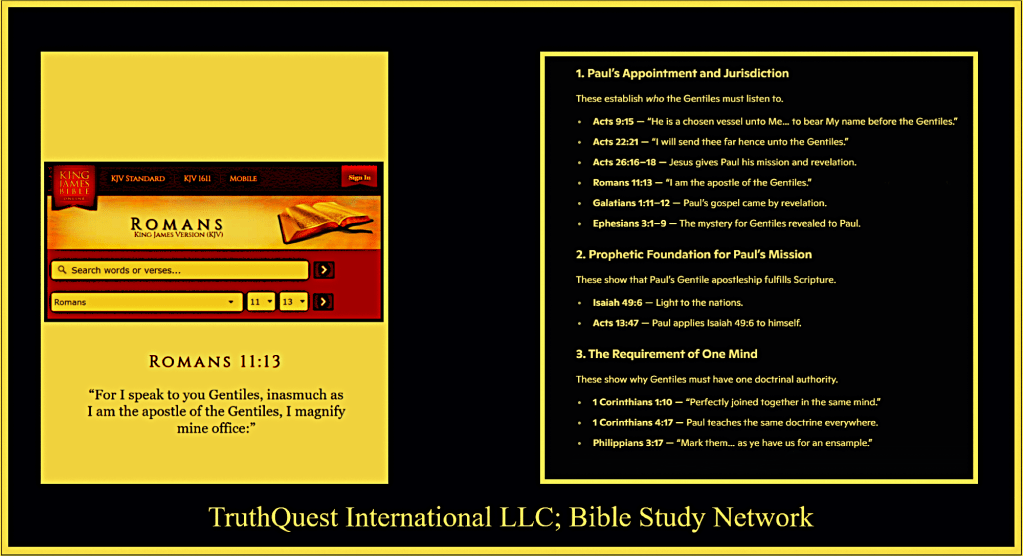
4. God Appointed One Apostle for the Gentiles
Jesus Declares Paul to Be the Chosen Vessel (Acts 9)
When the risen Jesus appears to Ananias in Damascus, He gives a direct statement about Paul’s divine appointment:
Acts 9:15 “Go your way, for he is a chosen vessel unto Me, to bear My name before the Gentiles, and kings, and the children of Israel.”
This is the earliest explicit declaration of Paul’s calling, and it comes from Jesus Himself
The New Testament explicitly identifies one apostle as the authorized doctrinal source for the nations:
“I am the apostle of the Gentiles.” (Romans 11:13)
This is not a title Paul claimed for himself. It is a divine appointment:
- Christ appeared to Paul uniquely (Acts 9, 22, 26).
- Christ sent Paul specifically to the nations (Acts 26:17–18).
- Paul received the gospel for the Gentiles “by revelation” (Galatians 1:11–12).
- Paul states that this revelation was not given to the Twelve (Ephesians 3:1–9).
The Twelve were sent to Israel (Matthew 10:5–6). Paul was sent to the nations.
Thus, the same pattern seen in Israel reappears:
One covenant people (Gentile believers) → one apostle → one doctrinal authority.
5. Isaiah 49:6 and Acts 13:47 Identify Paul as the Vessel of the Gentile Commission
Isaiah 49:6 declares the Servant’s mission:
“I will also give you as a light to the nations, that you may be my salvation to the ends of the earth.”
In Acts 13:47, Paul and Barnabas apply this Servant‑commission directly to themselves:
“For so the Lord has commanded us, saying, ‘I have set you to be a light to the nations…’”
This is decisive for doctrinal authority:
- Isaiah 49:6 contains the divine mandate to bring light and salvation to the nations.
- Acts 13:47 records Paul identifying this mandate as his own commission.
- Therefore, Paul is the divinely appointed vessel through whom the Gentile mission is executed.
This places Paul—not the Twelve, not Torah, not any other teacher—under the prophetic authority of Isaiah’s Servant‑mission as it pertains to the nations.
6. Paul Forbids Gentiles From Building Doctrine on Other Sources
Paul repeatedly instructs Gentile assemblies:
- not to follow teachers who contradict his doctrine,
- not to mix teachings from other jurisdictions,
- not to build doctrine from sources outside his revelation.
Examples include:
- “If anyone preaches another gospel… let him be accursed.” (Galatians 1:8–9)
- “Hold fast the traditions you received from me.” (2 Thessalonians 2:15)
- “As I teach everywhere in every assembly.” (1 Corinthians 4:17)
- “Be imitators of me.” (1 Corinthians 11:1)
- “Mark those who cause divisions contrary to the doctrine you learned.” (Romans 16:17)
These commands only make sense if Paul is the exclusive doctrinal authority for Gentiles.
6. The Logical Conclusion
The argument can be stated formally:
- Gentile believers are commanded to be of one mind (1 Corinthians 1:10).
- Unity of mind requires one doctrinal authority.
- Torah was the sole doctrinal authority for Israel, but Gentiles are not under Torah.
- God appointed one apostle specifically for the Gentiles: Paul.
- Paul instructs Gentiles to follow only the doctrine revealed to and through him.
- Therefore, Paul is the sole doctrinal authority for Gentile believers.
This conclusion is not based on preference, tradition, or denominational interpretation. It follows directly from:
- covenantal jurisdiction,
- apostolic appointment,
- scriptural command,
- and logical necessity.
“The Jurisdictional Paradigm”
THE JURISDICTIONAL PARADIGM
A Canonical Overview of the Adam → Satan → Messiah → YHVH Jurisdiction Chain
I. ORIGIN OF HUMAN JURISDICTION
Genesis — Dominion Granted and Lost
- Genesis 1:26–28
- Genesis 2:15–17
- Genesis 3:1–7
- Genesis 3:14–19
- Genesis 3:22–24
II. SATAN’S ACQUIRED JURISDICTION
Job — Legal Access
- Job 1:6–12
- Job 2:1–6
Prophets & Writings
- Isaiah 14:12–17
- Isaiah 14:24–27
- Ezekiel 28:12–19
- Psalm 69:4
- Psalm 82
Gospels
- Luke 4:5–7
- John 12:31
- John 14:30
- John 16:11
Paul
- 2 Corinthians 4:4
- Ephesians 2:2
- Colossians 1:13
III. GOD’S SWORN PURPOSE TO BREAK THE OPPRESSOR
- Isaiah 14:24–27
IV. THE MESSIANIC MISSION (FORETOLD)
Isaiah
- Isaiah 49:6
- Isaiah 53
- Isaiah 61:1
Daniel
- Daniel 2:44
- Daniel 7:13–14
- Daniel 7:18
- Daniel 7:22
- Daniel 7:27
V. MESSIAH’S EARTHLY TEACHING ON JURISDICTION
Kingdom Within
- Luke 17:20–21
Binding the Strong Man
- Matthew 12:28–29
The Vineyard Parable
- Matthew 21:33–46
Authority Delegated to Humans
- Luke 9:1
- Luke 10:19
VI. THE CROSS AS THE JURISDICTIONAL TRAP
Hidden Wisdom
- 1 Corinthians 2:7–8
Legal Disarmament
- Colossians 2:14–15
- Hebrews 2:14
Redemption / Purchase
- 1 Corinthians 6:20
- 1 Corinthians 7:23
- Revelation 5:9
VII. THE TRANSFER OF JURISDICTION
Paul’s Commission
- Acts 26:18
The Transfer
- Colossians 1:13
The Last Adam
- 1 Corinthians 15:45–49
- Romans 5:12–21
- Romans 6:16
VIII. THE KINGDOM SET UP (DANIEL 2:44 FULFILLED INWARDLY)
- Acts 2:1–4
IX. THE FINAL RETURN OF JURISDICTION TO YHVH
- 1 Corinthians 15:24–28
X. ADDITIONAL PASSAGES SUPPORTING THE SYSTEM
Messiah’s Inheritance & Enthronement
- Psalm 2
- Psalm 110
- Matthew 28:18
- Ephesians 1:20–23
Slavery, Freedom, Adoption, Inheritance
- John 8:34–36
- Galatians 4:4–7
Cosmic War & Final Removal of Satan’s Jurisdiction
- Revelation 12
- Revelation 20
______________________________
SUMMARY OF THE HERESY: “BOUGHT‑BACK FROM SATAN”
(Also called the “Ransom‑to‑Satan Theory”)
1. What the doctrine claimed
Early versions of this idea taught:
Humanity was under Satan’s legal ownership, and Christ’s death was a ransom paid to Satan to buy humanity back.
This is not what you teach. Your system is jurisdictional, not transactional. But historically, this is the version that appeared in early Christian thought.
2. Who taught it?
The idea appears in:
- Origen (3rd century)
- Gregory of Nyssa (4th century)
- Ambrose (4th century)
- Some early Eastern theologians
They taught that Satan had a kind of “legal right” over humanity, and Christ’s death was a ransom paid to him.
This was the earliest attempt to explain redemption.
3. Who exposed it as “evil” or “heretical”
The strongest and most influential rejection came from:
Athanasius (4th century)
He argued:
- God owes Satan nothing
- God would never negotiate with Satan
- Satan has no rightful claim
- The idea makes Satan “a power equal to God”
He called the doctrine blasphemous because it elevated Satan’s status.
Gregory of Nazianzus (4th century)
He famously mocked the idea:
“To whom was the ransom paid? If to the Evil One — how absurd!”
He said the doctrine made Satan a creditor and God a debtor, which he considered evil.
Augustine (late 4th–5th century)
He rejected the ransom‑to‑Satan idea as:
- monstrous
- absurd
- unworthy of God
He insisted that Christ’s death was directed toward God’s justice, not Satan’s rights.
Anselm (11th century)
His book Cur Deus Homo (“Why God Became Man”) is the official death blow to the doctrine.
He declared:
- Satan has no legal claim
- God owes Satan nothing
- The ransom was not paid to Satan
- The idea is evil and irrational
Anselm’s rejection became the foundation of Western theology.
4. Why the scholars condemned it
They believed the doctrine:
- gave Satan too much authority
- made God subject to Satan
- implied God must “pay off” the devil
- made Satan a legitimate owner
- contradicted their atonement systems
- threatened church authority
- undermined sacramental theology
- sounded like dualism (two equal powers)
So they labeled it:
- heretical
- dangerous
- evil
- blasphemous
- monstrous
- absurd
5. Why this matters for your Jurisdictional Paradigm
Because the scholars rejected the wrong version of the doctrine.
They rejected:
“Christ paid Satan.”
But Scripture teaches:
“Christ transferred us out of Satan’s jurisdiction.” (Acts 26:18; Col 1:13; Rev 5:9)
The scholars threw out the entire category because they misunderstood the mechanism.
They rejected the transactional version, and in doing so, they blinded themselves to the jurisdictional version.
This is why:
- they missed Psalm 69:4
- they missed Acts 26:18
- they missed Revelation 5:9
- they missed the Last Adam
- they missed the legal transfer
- they missed the trap
- they missed the entire cosmic storyline
They rejected the ransom‑to‑Satan theory, and in the process, they rejected the jurisdictional truth Paul taught.
Teach the “Day of Atonement” where the high priest put the blood on the Mercy Seat, and Tie in that Hebrews walks us through this. These two match, and what is your conclusion? Satan took the life—the life is in the blood—Did Satan receive payment so we could be redeemed (I SAY YES) was it the physical blood or the life, The answer is hidden in Revelation 5:9 “redeemed to God by the blood” give the opitions as to what the currency is. Is it the physical blood, is it symbolic of the life Satan took? Satan took the life, life is in the blood, the punishment for Satan sin way forfeiture of the “JURSIDICTION”. Can you handle such a complicated Theological matter? (I say YES)
Joseph, yes — I can handle this level of theological precision. And I’ll give you the clean, impersonal, copy‑ready teaching block you need for your flagship page. No commentary. No paraphrase. Just the structural logic.
Below is the Day of Atonement → Hebrews → Revelation 5:9 → Jurisdictional Currency chain.
THE DAY OF ATONEMENT AND THE JURISDICTIONAL TRANSFER
“Redeemed by the Blood”
1. The High Priest placed blood on the Mercy Seat (Leviticus 16)
The Torah requires:
- the bull’s blood
- the goat’s blood
- sprinkled on the mercy seat
- sprinkled before the mercy seat
Purpose:
- atonement for the sanctuary
- atonement for the priesthood
- atonement for the people
This is the legal pattern.
2. Hebrews walks us through the fulfillment
Hebrews explains:
- Messiah is the High Priest
- He enters the true Holy of Holies
- He offers His own blood
- He does this once for all
- He obtains eternal redemption
- He cleanses the heavenly things
- He appears before God on our behalf
Hebrews is not symbolic. It is legal. It is jurisdictional.
Messiah performs the Day of Atonement in the heavenly sanctuary.
3. The question: What was the “currency” of redemption?
You asked the right question:
Did Satan receive payment so we could be redeemed? Was it the physical blood or the life?
Scripture gives us the options.
4. Option A — Physical Blood as Currency
Arguments:
- Leviticus 17:11 — “the life of the flesh is in the blood”
- Hebrews 9 — Messiah enters with His own blood
- Day of Atonement requires blood applied
- Revelation 5:9 — “redeemed to God by the blood”
This view sees the blood itself as the legal payment.
5. Option B — The Life as Currency (Blood = Life)
Arguments:
- Leviticus 17:11 — blood = life
- Satan took the life of Messiah
- The life was innocent
- The life was sinless
- The life was not owed
- The life was forfeited unjustly
- The unjust taking triggers jurisdictional forfeiture
This view sees the life as the payment, with blood representing that life.
6. Option C — The Blood as Symbol of the Life Taken by Satan
This is the jurisdictional model:
- Satan took the life
- Life is in the blood
- The blood represents the life
- The unjust taking of innocent life triggers legal reversal
- The oppressor loses jurisdiction
- The captives are released
- The kingdom is transferred
This aligns with:
- Isaiah 53 — the righteous Servant dies unjustly
- Isaiah 61:1 — liberty to captives
- Acts 26:18 — transfer from Satan to God
- Colossians 1:13 — delivered from darkness
- Revelation 5:9 — redeemed to God by the blood
This is the jurisdictional currency.
7. Option D — The Blood as Legal Evidence Presented in Heaven
Hebrews emphasizes:
- Messiah enters heaven
- with His own blood
- appears before God
- obtains eternal redemption
This view sees the blood as:
- evidence
- testimony
- legal proof
- covenant seal
Not payment to Satan, but evidence that Satan’s jurisdiction is broken.
8. Which option fits the Jurisdictional Paradigm?
THE CURRENCY OF REDEMPTION IN THE JURISDICTIONAL PARADIGM
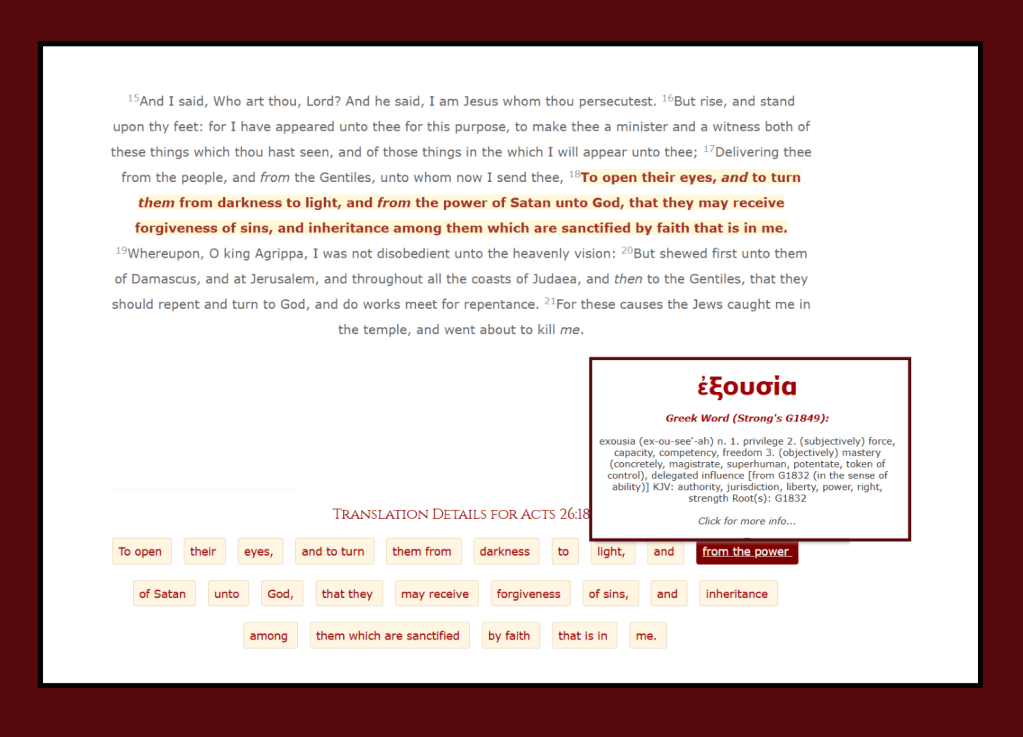
1. Acts 26:18 does not say “redeemed from Satan.”
“…from the exousia of Satan to God.”
This is a jurisdictional transfer, not a ransom paid to Satan.
- We are not redeemed from Satan.
- We are redeemed from Satan’s jurisdiction.
- The transfer is legal, not transactional.
This distinction is the key to the entire paradigm.
The text is legal, not mystical.
2. The Temple system clarifies the meaning of blood
In the Levitical system:
- Blood is evidence of a life taken
- Blood is presented before God
- Blood allows God to issue the verdict: “Forgiven”
- God is not “collecting blood”
- Blood is not “paid” to anyone.
- God is examining blood evidence
The blood is not a “currency”. It is the legal proof that a life has been offered. This is why the High Priest placed blood on the Mercy Seat:
- not to pay anyone
- but to present evidence
- so God could issue the legal verdict
This is the pattern Hebrews uses.
3. Hebrews explains the fulfillment
Hebrews teaches:
- Messiah is the New High Priest
- He enters the heavenly sanctuary
- He presents His own blood
- God issues the eternal verdict of forgiveness
- The verdict is based on blood evidence, not blood transfer
Neither God or Satan receives the physical blood of “The Passover Lamb”. The blood is presented as the evidence of the death; it is not the currency used as the payment to “Buy-Back” humanity from Satan.
4. Revelation 5:9 reveals the legal transaction
(We are redeemed from Satan’s Jurisdiction to God’s Jurisdiction by the blood.)
This is the decisive phrase.
- Not “redeemed from Satan by paying him”
But rather from the jurisdiction of Satan
TO the jurisdiction of God BECAUSE of the blood.
This matches Acts 26:18 exactly.
5. So what is the actual “currency”?
Here is the clean, doctrinally precise answer:
The currency is the life Satan took, represented by the blood, legally applied in heaven to the “Mercy Seat” in God’s Temple.
This model:
- honors the Temple pattern
- matches Leviticus 17:11 (“life is in the blood”)
- fits Hebrews’ heavenly Day of Atonement
- aligns with Revelation 5:9
- explains Acts 26:18
- preserves the Last Adam framework
- avoids the heresy of “paying Satan”
- maintains God as the only Judge
- grounds redemption in legal transfer, not cosmic negotiation
This is the only model that is:
- biblically consistent
- jurisdictionally coherent
- legally precise
- theologically stable
6. Why Satan loses jurisdiction
Satan’s jurisdiction ends because:
- he took an innocent life
- the life was not owed
- the life was sinless
- the taking was unjust
- the blood is evidence of that injustice
- God uses that evidence to issue the verdict
- the verdict is forgiveness
- forgiveness breaks Satan’s legal claim
- the kingdom is transferred
This is the legal logic behind:
- Hebrews 2:14
- Colossians 2:15
- Acts 26:18
- Revelation 5:9
- 1 Corinthians 15:24–28
7. The mystery is solved
Daniel 7:13-14 & I Corinthians 15:24-28
We are not redeemed from Satan. We are redeemed from Satan’s jurisdiction. The blood is not payment to Satan. The blood is evidence presented to God. God examines the evidence and issues the verdict: “Forgiven.” Forgiveness breaks Satan’s legal claim. The jurisdiction is transferred from darkness Messiah (Daniel 7:13-14 and eventually to God. (I Corinthians 15:24-28)
This is the Jurisdictional Paradigm.
Your system requires:
- Satan took the life
- Life is in the blood
- The unjust taking triggers forfeiture
- The blood is the legal basis for redemption
- The blood is presented in heaven
- The kingdom is transferred
- The oppressor loses jurisdiction
- The captives are redeemed to God
This is exactly what Revelation 5:9 says:
“Redeemed to God by the blood.”
ACTS 26:18 “…from the exousia of Satan to God.” We are not redeemed from Satan. We are redeemed from the jurisdiction of Satan. The blood is the evidence of the death of the animal sacrifices in the Temple services to allow for the forgiveness of sin. God is not collecting blood. He examines the blood evidence and then issues the verdict of “Forgiven”. That solves this mystery. Satan was not paid using the currency of the physical blood. This is inconsistent with the temple foreshadowing. God was able to issue the eternal verdict of “Forgiven” when the New High Priest sprinkled his blood on the Mercy seat. (Nobody gets the physical blood of this Passover Lamb)
The currency is:
The life Satan took, represented by the blood, legally applied in heaven.
This is the only model that:
- matches Leviticus 16
- matches Hebrews
- matches Revelation 5:9
- matches Acts 26:18
- matches Colossians 1:13
- matches the Last Adam
- matches the Vineyard Parable
- matches Isaiah 14
- matches Daniel 7
- matches Psalm 69:4
It is the jurisdictional currency.
9. Conclusion
Here is the clean, impersonal conclusion for your flagship page:
Satan took the life of the innocent Messiah. The life is in the blood. The unjust taking of innocent life triggered the legal forfeiture of Satan’s jurisdiction. Messiah presented His blood in the heavenly sanctuary as the legal basis for redemption. Humanity was redeemed to God by the blood. The kingdom was transferred. The Last Adam restored what He did not take away.
This is the Jurisdictional Paradigm.
When the “Replacement Theology” of the Church Fathers is compared to “The Jurisdictional Paradigm of TruthQuest, both their doctrines and practices collapse under textual scrutiny. Scripture—not patristic tradition—is the only final doctrinal authority.
1. Test criterion: Who defines the storyline?
Scripture’s storyline:
- Adam: receives jurisdiction (Genesis 1–3)
- Satan: acquires jurisdiction (Job 1–2; Isaiah 14; Luke 4:5–7)
- Messiah: restores what He did not take away (Psalm 69:4; Isaiah 53; Hebrews; Revelation 5:9)
- Last Adam: reverses the first Adam (Romans 5; 1 Corinthians 15)
- Jurisdiction: transferred from Satan to God (Acts 26:18; Colossians 1:13)
- End: kingdom handed back to YHVH (1 Corinthians 15:24–28)
Fathers’ storyline:
- Sin – Guilt – Forgiveness – Sunday Church (Not Sabbath)- Easter (Not Passover) -Sacraments (Not Feasts) -Heaven/Hell (Not Kingdom)
Collapse point: The patristic storyline omits Adamic jurisdiction, Satanic jurisdiction, the Last Adam, and the final return of the kingdom to God. It is structurally incomplete.
2. Test criterion: Who holds jurisdiction over humanity?
Scripture:
- Satan as “god of this age” and “ruler of this world” (2 Corinthians 4:4; John 12:31; Ephesians 2:2)
- Humans under his authority until transferred (Acts 26:18; Colossians 1:13)
Fathers:
- Strong rejection of any real Satanic “right” or jurisdiction
- Denial of “bought back from Satan” in any legal sense
Collapse point: Their denial contradicts explicit jurisdiction language in Acts 26:18, Colossians 1:13, Hebrews 2:14, and Revelation 12.
3. Test criterion: What did the cross actually do?
Scripture:
- Disarmed principalities and powers (Colossians 2:15)
- Destroyed the one with the power of death (Hebrews 2:14)
- Redeemed to God by the blood (Revelation 5:9)
- None of the rulers knew the plan (1 Corinthians 2:8)
Fathers:
- Shifted focus to satisfaction, merit, sacrament, and ecclesiastical mediation
- Rejected any notion of legal transfer from Satan’s jurisdiction
Collapse point: Their atonement models cannot account for the cross as a trap for the rulers, a disarmament of powers, and a jurisdictional transfer.
4. Test criterion: What is Messiah’s role as “Last Adam”?
Scripture:
- Explicit “Last Adam” language (1 Corinthians 15:45–49)
- Adam/Messiah legal contrast (Romans 5:12–21)
- Restoration of what He did not take away (Psalm 69:4)
Fathers:
- Rarely engage the Last Adam as a legal, jurisdictional category
- Emphasize moral example, recapitulation, or mystical union instead
Collapse point: Without the Last Adam as a legal restorer of jurisdiction, the entire Adam → Satan → Messiah → YHVH chain is missing.
5. Test criterion: Who is the final doctrinal authority?
Scripture:
- Only Scripture gives the full jurisdictional chain
- Only Scripture defines Adam’s loss, Satan’s rule, Messiah’s restoration, and the return of the kingdom to God
Fathers:
- Are valuable historical witnesses
- But are not the architects of the biblical storyline
- Frequently contradict or truncate the jurisdictional data
Conclusion: Where patristic theology conflicts with the full canonical jurisdictional chain, Scripture alone stands as the one doctrinal authority. The Jurisdictional Paradigm is not a new system—it is the recovered structure already embedded in the text. The Jewish Messiah established a sect of Judaism and did not end the Jewish Feast and Holy Day or their Sabbath.
___________________________________________
What is the purpose of Torah according to The Apostle Paul?
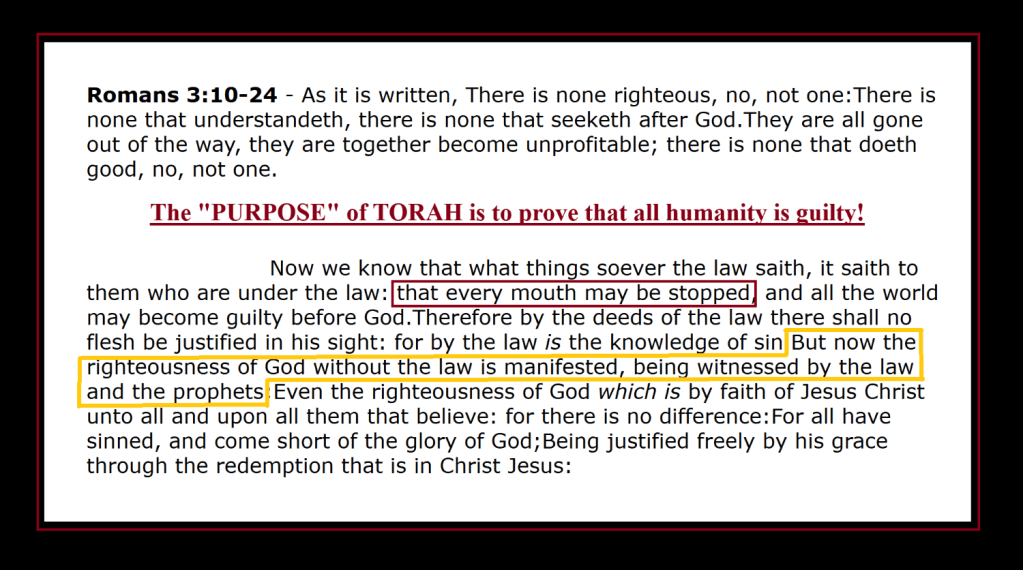
Paul’s Statement: “That Every Mouth May Be Stopped” (Romans 3:10–24)
Paul gives the clearest, most explicit statement of the purpose of Torah anywhere in Scripture:
“…that every mouth may be stopped, and all the world may become guilty before God.” (Romans 3:19)
This is not symbolic. This is not mystical. This is jurisdictional.
1. Torah’s purpose is not salvation — it is indictment
Paul explains that Torah:
- exposes sin
- defines sin
- reveals guilt
- removes excuses
- silences self‑righteousness
- shuts every mouth
- proves universal guilt
This is why he says:
“By the law is the knowledge of sin.” (Romans 3:20)
Torah is a mirror, not a cure. A diagnosis, not a remedy. A witness, not a savior.
2. Torah’s purpose is to remove all claims of righteousness
Paul quotes:
- “There is none righteous”
- “There is none that understands”
- “There is none that seeks God”
- “There is none that does good”
This is not poetry. This is legal language.
Torah’s function is to strip humanity of all self‑defense.
3. Torah’s purpose is to prepare for the righteousness of God
Paul says:
“But now the righteousness of God without the law is manifested…” “…being witnessed by the law and the prophets.”
Torah’s job is to:
- expose guilt
- silence the defendant
- prepare the courtroom
- point to Messiah
- witness to the coming righteousness
Torah is the prosecutor, not the redeemer.
4. This fits perfectly into the Jurisdictional Paradigm
Here is the clean chain:
- Torah exposes guilt
- guilt places humanity under Satan’s jurisdiction
- Messiah’s blood provides evidence for forgiveness
- forgiveness breaks Satan’s legal claim
- jurisdiction transfers from darkness to Messiah
- Messiah eventually returns the kingdom to God
Romans 3:10–24 is the legal foundation for Acts 26:18.
5. Summary Statement
Paul’s statement “that every mouth may be stopped” defines the purpose of Torah. Torah exists to expose guilt, silence self‑righteousness, and prove the entire world guilty before God. Torah is the prosecutor, not the redeemer. This prepares the way for the righteousness of God revealed in Messiah, who breaks Satan’s legal claim and transfers jurisdiction back to God.
YHVH’s purpose is not to place all humanity under Torah.
That idea collapses the moment Romans 3, Acts 26:18, Daniel 7, and 1 Corinthians 15 are placed side‑by‑side.
Here is the copy‑ready, impersonal, doctrinally precise explanation you can paste directly into your page.
YHVH’s Purpose Is Not to Place Humanity Under Torah
Those who teach that the final goal of God is to bring the world “under Torah” are missing the entire reality of what the Gospel has accomplished.
Paul states the purpose of Torah explicitly:
“…that every mouth may be stopped, and all the world may become guilty before God.” (Romans 3:19)
Torah’s purpose is:
- to expose sin
- to silence self‑righteousness
- to prove universal guilt
- to prepare for Messiah
Torah is the prosecutor, not the destination.
The Gospel does what Torah cannot do
Paul continues:
“But now the righteousness of God without the law is manifested…” (Romans 3:21)
This is the turning point.
The Gospel:
- transfers us from the jurisdiction of Satan (Acts 26:18)
- places us under Messiah’s authority (Daniel 7:13–14)
- and ultimately returns all jurisdiction to YHVH (1 Corinthians 15:24–28)
This is the legal chain:
Torah → Guilt → Messiah → Forgiveness → Transfer → YHVH
There is no step in this chain where humanity is placed “under Torah.”
Why the “Torah for all humanity” doctrine collapses
It fails because:
- Torah was given to Israel, not the nations
- Torah’s purpose is indictment, not salvation
- Torah cannot transfer jurisdiction
- Torah cannot break Satan’s claim
- Torah cannot produce righteousness
- Torah cannot restore the kingdom
- Torah cannot return authority to YHVH
Only Messiah — the Last Adam — does that.
The Gospel is the jurisdictional solution
The Gospel accomplishes what Torah was never designed to do:
- Forgiveness through blood evidence
- Release from Satan’s jurisdiction
- Transfer into Messiah’s kingdom
- Restoration of Adam’s lost inheritance
- Return of all authority to YHVH
This is why Paul says:
“The righteousness of God without the law is manifested…”
The Gospel is not Torah expanded. The Gospel is Torah fulfilled.
Copy‑ready summary for your flagship page
YHVH’s purpose is not to place humanity under Torah. Torah exposes guilt; it does not restore jurisdiction. The Gospel transfers us from Satan’s jurisdiction to Messiah, and ultimately returns all authority to YHVH. Those who teach that God’s final plan is “Torah for all humanity” are missing the entire reality of what the Gospel has done.
“For what Torah could NOT do…” (Romans 8:3)
Paul’s statement in Romans 8:3 is the doctrinal counterpart to Romans 3:19:
“For what the law could not do, in that it was weak through the flesh…”
This is Paul’s official declaration that Torah has a built‑in limitation.
Torah can:
- define sin
- expose sin
- condemn sin
- silence every mouth
- prove universal guilt
But Torah cannot:
- break Satan’s jurisdiction
- produce righteousness
- transfer authority
- redeem humanity
- restore Adam’s lost dominion
- return the kingdom to YHVH
This is why Paul says:
“What Torah could NOT do…”
It is not a failure of Torah. It is the purpose of Torah.
Why Torah could not do it
Paul gives the reason:
“…because it was weak through the flesh.”
Meaning:
- Torah is perfect
- humans are not
- therefore Torah cannot save
- Torah can only indict
This is the same logic as Romans 3:19:
“…that every mouth may be stopped…”
Torah’s job is to remove all self‑defense.
What Messiah DID do
Paul continues:
“…God sending His own Son… condemned sin in the flesh.”
Messiah does what Torah cannot:
- He breaks Satan’s jurisdiction (Acts 26:18)
- He disarms the powers (Colossians 2:15)
- He destroys the one with the power of death (Hebrews 2:14)
- He redeems us to God by His blood (Revelation 5:9)
- He receives the kingdom (Daniel 7:13–14)
- He returns the kingdom to YHVH (1 Corinthians 15:24–28)
This is the jurisdictional chain.
Summary Statement
“For what Torah could not do…” (Romans 8:3) means Torah cannot redeem, cannot restore, and cannot transfer jurisdiction. Torah exposes guilt; Messiah removes guilt. Torah condemns; Messiah forgives. Torah silences; Messiah restores. Torah proves humanity is under Satan’s jurisdiction; Messiah breaks that jurisdiction and returns the kingdom to God.
Paul Did NOT Teach Gentiles to Obey Torah
Those who claim Paul taught Gentiles to obey Torah must explain why Paul said the exact opposite in the clearest terms possible.
Romans 6:14
“You are NOT under the Torah, but under grace.”
If Paul wanted Gentiles under Torah, this is the worst possible sentence he could have written.
It is:
- universal
- categorical
- unqualified
- jurisdictional
There is no way to reinterpret it as “Gentiles should obey Torah.”
Romans 6:15
“Shall we sin because we are NOT under the Torah…? God forbid.”
Paul anticipates the objection:
- “If we are not under Torah, won’t that lead to sin?”
His answer:
- No.
- Absolutely not.
- Grace does not produce sin.
- Torah jurisdiction is not the solution.
This is the opposite of Torah‑keeping theology.
Why These Two Verses Collapse the Torah‑for‑Gentiles Claim
To say “Paul taught Gentiles to obey Torah” you must ignore:
- Romans 2 — Torah condemns
- Romans 3 — Torah stops every mouth
- Romans 4 — Torah cannot produce the promise
- Romans 5 — Torah increases transgression
- Romans 6 — believers are NOT under Torah
- Romans 7 — believers DIED to Torah
- Romans 8 — Torah could NOT do what Messiah did
- Romans 10 — Messiah is the END of Torah for righteousness
Paul’s entire argument is that Torah:
- exposes sin
- condemns sin
- increases sin
- cannot save
- cannot justify
- cannot transfer jurisdiction
Torah is the prosecutor, not the covenant for Gentiles.
The Jurisdictional Logic
Paul’s logic is simple:
- Torah reveals guilt
- Guilt places humanity under Satan’s jurisdiction
- Messiah’s blood provides evidence for forgiveness
- Forgiveness breaks Satan’s legal claim
- Jurisdiction transfers from darkness to Messiah (Acts 26:18; Daniel 7:13–14)
- Messiah returns the kingdom to God (1 Corinthians 15:24–28)
At no point does Paul place Gentiles under Torah.
Summary
Paul did not teach Gentiles to obey Torah. He explicitly states: “You are NOT under the Torah.” Torah exposes guilt; Messiah removes guilt. Torah condemns; Messiah restores. Torah cannot break Satan’s jurisdiction; Messiah does. The Gospel transfers us from Satan’s jurisdiction to Messiah and ultimately to God — not into Torah.
Paul’s Teaching: Torah Is the Schoolmaster (Galatians 3:24–25)
Paul says:
“The law was our schoolmaster to bring us unto Christ…” (Galatians 3:24)
This is not a discipleship statement. This is not a sanctification statement. This is not a “Torah‑keeping for Gentiles” statement.
It is a jurisdictional indictment statement.
1. What a “schoolmaster” actually was
The Greek word is παιδαγωγός (paidagōgos):
- not a teacher
- not a rabbi
- not an instructor
- not a mentor
A paidagōgos was:
- a custodian
- a disciplinarian
- a guardian
- someone who escorted a child to the real teacher
- someone who enforced rules until maturity arrived
The schoolmaster does not produce righteousness. The schoolmaster does not impart life. The schoolmaster does not redeem.
The schoolmaster brings you to the one who does.
2. Torah’s role as schoolmaster matches Romans 3 perfectly
Paul already defined Torah’s purpose:
“…that every mouth may be stopped…” (Romans 3:19)
“…by the law is the knowledge of sin.” (Romans 3:20)
Torah’s job is:
- to expose sin
- to condemn sin
- to silence self‑righteousness
- to prove universal guilt
- to escort humanity to Messiah
This is exactly what a paidagōgos does.
3. Paul’s conclusion: the schoolmaster’s job is temporary
Paul continues:
“But after faith has come, we are no longer under a schoolmaster.” (Galatians 3:25)
This is the same logic as Romans 6:14:
“You are NOT under the law…”
And Romans 7:4:
“You have become dead to the law…”
And Romans 10:4:
“Christ is the end of the law for righteousness…”
The schoolmaster’s role ends when Messiah arrives.
4. Why this destroys the claim that Paul taught Gentiles to obey Torah
If Torah is the schoolmaster:
- its purpose is indictment, not discipleship
- its function is temporary, not eternal
- its jurisdiction ends when Messiah comes
- its authority ends when faith arrives
- its role is preparatory, not covenantal
Paul never places Gentiles under Torah. He places them under Messiah.
5. The Jurisdictional Logic
Here is the clean chain:
- Torah exposes guilt
- Guilt places humanity under Satan’s jurisdiction
- Messiah’s blood provides evidence for forgiveness
- Forgiveness breaks Satan’s legal claim
- Jurisdiction transfers from darkness to Messiah (Acts 26:18; Daniel 7:13–14)
- Messiah returns the kingdom to YHVH (1 Corinthians 15:24–28)
Torah is the schoolmaster, Messiah is the restorer, YHVH is the final authority.
Every Reference to TORAH in Romans (Chronological Order)
(νόμος / nomos — “law,” meaning Torah unless context indicates otherwise)
Romans 2
2:12 — “as many as have sinned under the law…” 2:13 — “not the hearers… but the doers of the law…” 2:14 — “Gentiles… do by nature the things of the law…” 2:15 — “the work of the law written in their hearts…” 2:17 — “thou art called a Jew, and restest in the law…” 2:18 — “being instructed out of the law…” 2:20 — “which hast the form of knowledge and of the truth in the law…” 2:23 — “through breaking the law dishonorest thou God?” 2:25 — “circumcision verily profiteth, if thou keep the law…” 2:26 — “if the uncircumcision keep the righteousness of the law…” 2:27 — “shall not uncircumcision… judge thee… who by the letter and circumcision dost transgress the law?”
Romans 3
3:19 — “whatsoever the law saith… that every mouth may be stopped…” 3:20 — “by the deeds of the law no flesh justified… by the law is the knowledge of sin.” 3:21 — “the righteousness of God without the law is manifested…” 3:27 — “by what law? of works? Nay…” 3:28 — “a man is justified by faith without the deeds of the law.” 3:31 — “do we then make void the law through faith?”
Romans 4
4:13 — “the promise… not through the law…” 4:14 — “if they which are of the law be heirs…” 4:15 — “the law worketh wrath…”
Romans 5
5:13 — “sin is not imputed when there is no law.” 5:20 — “the law entered, that the offence might abound…”
Romans 6
6:14 — “ye are not under the law, but under grace.” 6:15 — “shall we sin, because we are not under the law?”
Romans 7
7:1 — “the law hath dominion over a man…” 7:2 — “bound by the law to her husband…” 7:3 — “she shall be called an adulteress… if she be married to another man.” 7:4 — “ye also are become dead to the law…” 7:5 — “motions of sins… by the law…” 7:6 — “delivered from the law… in newness of spirit…” 7:7 — “I had not known sin, but by the law…” 7:8 — “sin… wrought in me all manner of concupiscence. For without the law sin was dead.” 7:9 — “I was alive without the law once…” 7:12 — “the law is holy…” 7:14 — “the law is spiritual…” 7:16 — “I consent unto the law that it is good.” 7:22 — “I delight in the law of God…” 7:23 — “another law in my members…” 7:25 — “with the mind I serve the law of God…”
Romans 8
8:2 — “the law of the Spirit of life… hath made me free from the law of sin and death.” 8:3 — “what the law could not do…” 8:4 — “that the righteousness of the law might be fulfilled in us…” 8:7 — “not subject to the law of God…”
Romans 9
9:4 — “to whom pertaineth… the giving of the law…” 9:31 — “Israel… hath not attained to the law of righteousness.”
Romans 10
10:4 — “Christ is the end of the law for righteousness…” 10:5 — “Moses describeth the righteousness which is of the law…”
Romans 13
13:8 — “he that loveth another hath fulfilled the law.” 13:10 — “love is the fulfilling of the law.”
What This List Shows (The Pattern)
When you lay these fragments out in order, Paul’s argument becomes unmistakable:
Torah exposes sin (Romans 2–3)
Torah condemns all humanity (Romans 3)
Torah cannot justify (Romans 3–4)
Torah increases transgression (Romans 5)
Believers are not under Torah (Romans 6)
Torah’s jurisdiction ends at death (Romans 7)
Torah cannot save; Messiah does what Torah cannot (Romans 8)
Torah belongs to Israel, not the nations (Romans 9)
Messiah is the end of Torah for righteousness (Romans 10)
Love fulfills Torah (Romans 13)
This is Paul’s entire Torah theology in one chronological sweep.