
A Logical Proof for One Doctrinal Authority for Gentile Believers
1. The Requirement Be of: “One Mind”
Paul commands the assemblies of the nations to be:
“…perfectly joined together in the same mind and in the same judgment.” (1 Corinthians 1:10)
This requirement is impossible unless all Gentile believers draw doctrine from a single authoritative source. Multiple doctrinal sources inevitably produce multiple interpretations, which produce divisions. Paul identifies this as the root problem in Corinth:
- “I am of Paul”
- “I am of Apollos”
- “I am of Cephas”
- “I am of Christ”
- I follow Torah
The conclusion Paul draws is simple: Division arises when multiple teachers are treated as doctrinal authorities.
Therefore, unity of mind requires one doctrinal authority for Gentiles.
2. The Jewish Pattern: Torah as the Sole Doctrinal Authority
For Israel, the pattern is clear and undisputed:
- God gave one covenant at Sinai.
- God gave one law (Torah).
- God gave one authorized teaching office (the Levitical priesthood).
- Prophets and kings were judged by their conformity to that one Torah.
Thus, Israel’s unity of mind and practice came from one authoritative source.
This establishes a divine pattern:
One covenant people → one covenant → one doctrinal authority.
3. Gentiles Are Not Under the Sinai Covenant
Acts 15, Galatians, and Ephesians establish that Gentiles:
- are not placed under the Sinai covenant,
- are not commanded to keep Torah,
- are not required to undergo conversion,
- are not placed under the Levitical priesthood.
Therefore, Gentiles cannot use Torah as their doctrinal authority. A different covenantal jurisdiction requires a different doctrinal authority.
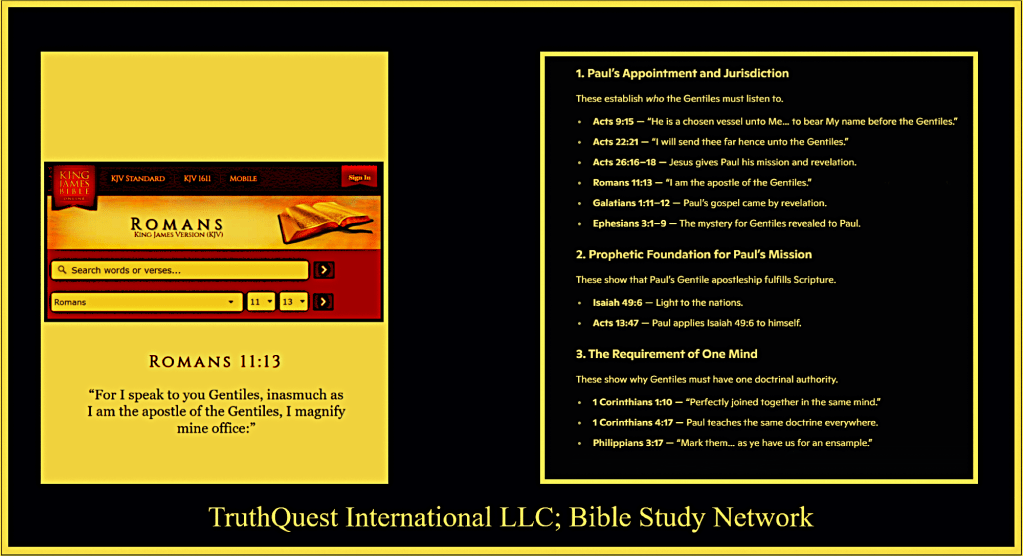
4. God Appointed One Apostle for the Gentiles
Jesus Declares Paul to Be the Chosen Vessel (Acts 9)
When the risen Jesus appears to Ananias in Damascus, He gives a direct statement about Paul’s divine appointment:
Acts 9:15 “Go your way, for he is a chosen vessel unto Me, to bear My name before the Gentiles, and kings, and the children of Israel.”
This is the earliest explicit declaration of Paul’s calling, and it comes from Jesus Himself
The New Testament explicitly identifies one apostle as the authorized doctrinal source for the nations:
“I am the apostle of the Gentiles.” (Romans 11:13)
This is not a title Paul claimed for himself. It is a divine appointment:
- Christ appeared to Paul uniquely (Acts 9, 22, 26).
- Christ sent Paul specifically to the nations (Acts 26:17–18).
- Paul received the gospel for the Gentiles “by revelation” (Galatians 1:11–12).
- Paul states that this revelation was not given to the Twelve (Ephesians 3:1–9).
The Twelve were sent to Israel (Matthew 10:5–6). Paul was sent to the nations.
Thus, the same pattern seen in Israel reappears:
One covenant people (Gentile believers) → one apostle → one doctrinal authority.
5. Isaiah 49:6 and Acts 13:47 Identify Paul as the Vessel of the Gentile Commission
Isaiah 49:6 declares the Servant’s mission:
“I will also give you as a light to the nations, that you may be my salvation to the ends of the earth.”
In Acts 13:47, Paul and Barnabas apply this Servant‑commission directly to themselves:
“For so the Lord has commanded us, saying, ‘I have set you to be a light to the nations…’”
This is decisive for doctrinal authority:
- Isaiah 49:6 contains the divine mandate to bring light and salvation to the nations.
- Acts 13:47 records Paul identifying this mandate as his own commission.
- Therefore, Paul is the divinely appointed vessel through whom the Gentile mission is executed.
This places Paul—not the Twelve, not Torah, not any other teacher—under the prophetic authority of Isaiah’s Servant‑mission as it pertains to the nations.
6. Paul Forbids Gentiles From Building Doctrine on Other Sources
Paul repeatedly instructs Gentile assemblies:
- not to follow teachers who contradict his doctrine,
- not to mix teachings from other jurisdictions,
- not to build doctrine from sources outside his revelation.
Examples include:
- “If anyone preaches another gospel… let him be accursed.” (Galatians 1:8–9)
- “Hold fast the traditions you received from me.” (2 Thessalonians 2:15)
- “As I teach everywhere in every assembly.” (1 Corinthians 4:17)
- “Be imitators of me.” (1 Corinthians 11:1)
- “Mark those who cause divisions contrary to the doctrine you learned.” (Romans 16:17)
These commands only make sense if Paul is the exclusive doctrinal authority for Gentiles.
6. The Logical Conclusion
The argument can be stated formally:
- Gentile believers are commanded to be of one mind (1 Corinthians 1:10).
- Unity of mind requires one doctrinal authority.
- Torah was the sole doctrinal authority for Israel, but Gentiles are not under Torah.
- God appointed one apostle specifically for the Gentiles: Paul.
- Paul instructs Gentiles to follow only the doctrine revealed to and through him.
- Therefore, Paul is the sole doctrinal authority for Gentile believers.
This conclusion is not based on preference, tradition, or denominational interpretation. It follows directly from:
- covenantal jurisdiction,
- apostolic appointment,
- scriptural command,
- and logical necessity.
 TruthQuest International LLC; Bible Study Network