For this Program we will use the same 169 “PASSKEYS” but use Movies, TV Programs, Locations and Famous People for the “Memory Anchors”.
The format is a 169-exhibit 🏛️museum. Behind each exhibit door is an unlimited storage vault and memory portal. The key to unlock any door is the two-letter reversable passkey that matches the exhibit number.
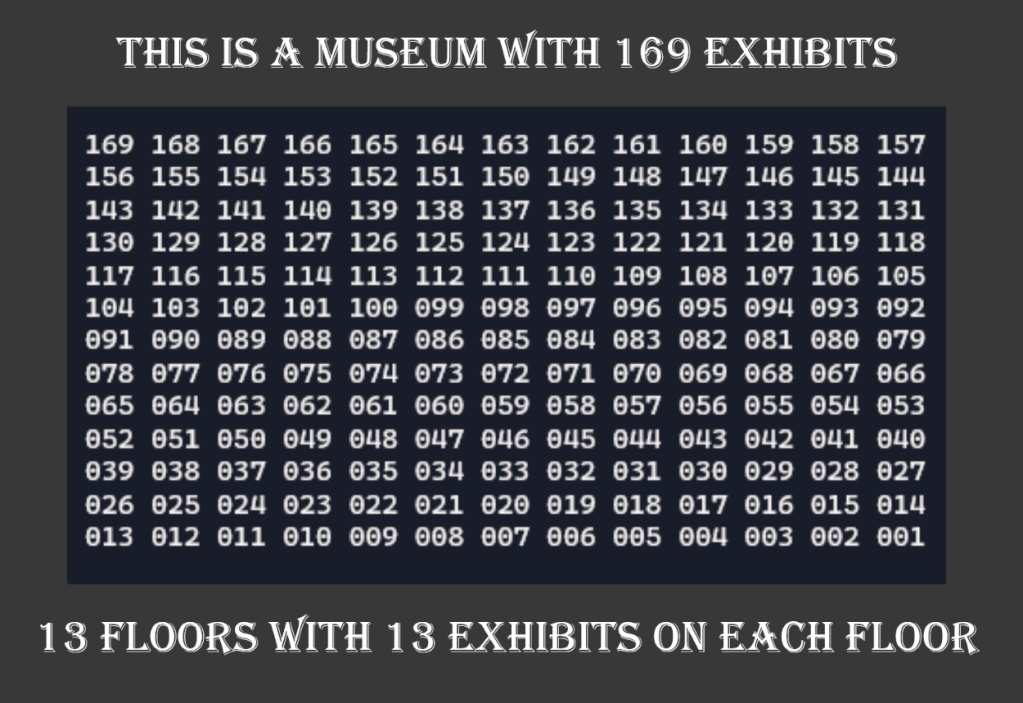
The 169 “Passkeys” are the intersecting point between the Floors & Columns.
The Columns (“X-Axis”) are on the bottom in Red and the Floors (“Y-axis”) are on the left in Blue.
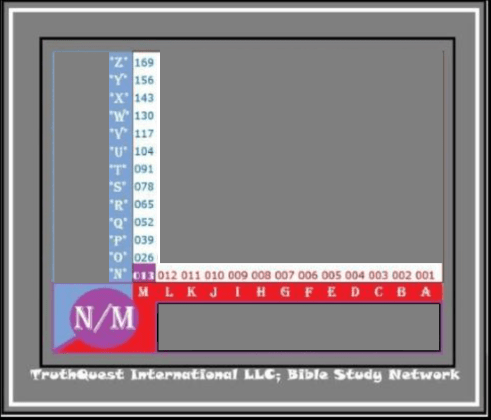

As seen above, the exhibit #070 is opened by the letters: “E/S or S/E”. Inside is stored whatever we associate with that “Memory Anchor”.
This image shows how words starting with “E” and having the first “Y-axis” letter being “S” graph at “070”. Words such as “escargot”, “escape” and Eastwood, are featured at “E/S or S/E” which replace the number 70.
Those words which start with “S” and have the first “X-axis” letter of “E”, also graph here, such as:
“Steven Seagal”.
The “E-Column” begins with the number 5 and add 13 steps to arrive at the next floor.
Our Therapy Sessions involve remembering the Column numbers, Passkeys, Memory Anchors and then the Memory stories that connect everything in that Column.
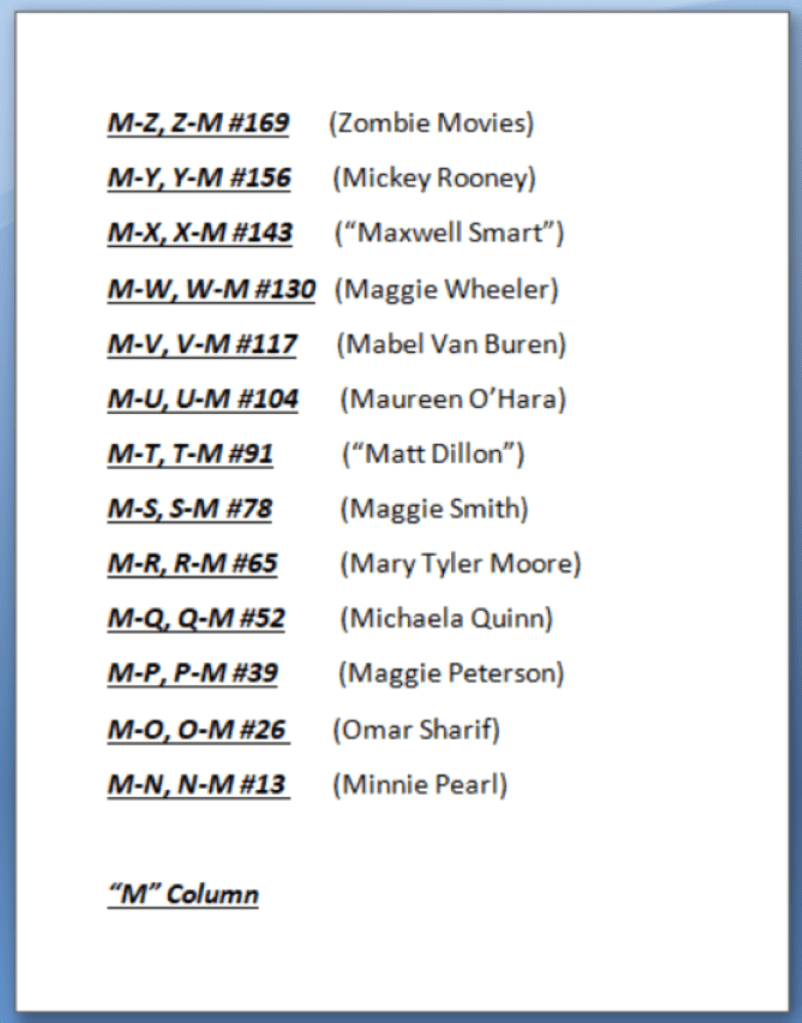
Below is an example using the top two exhibits on the “M-Column” #169 & #156:
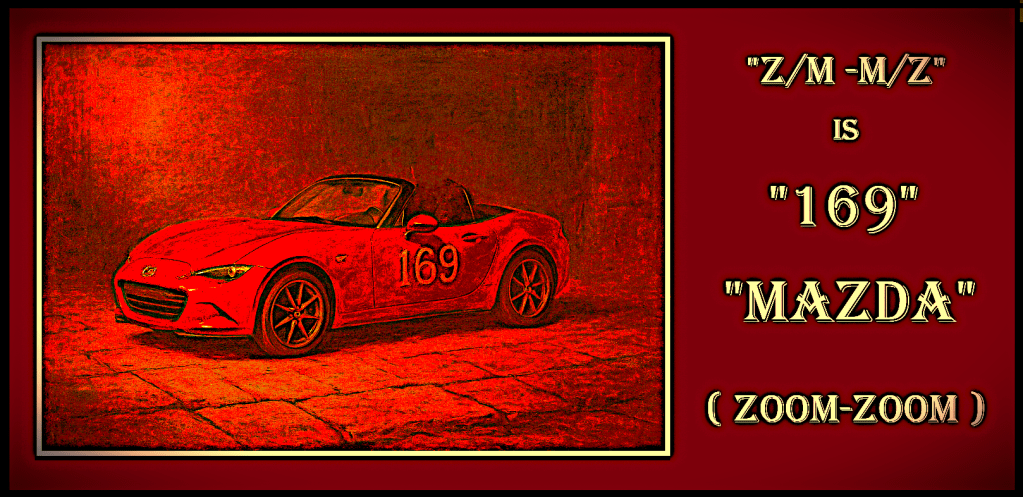

The memory stories do not need to be connected to the memory portal above or below for this memory system, BUT for use as a powerful “Neuroplasticity Therapy Session” is does.
SAMPLE STORY:
______________________________
“You counted your money and found that you had $169. left in your wallet. You invited your friends from the “ZOO” to eat “MAIZE” with you at “MICKEY’S” diner on 169th street. Everything was going great, until everyone hears police sirens getting louder and louder. Just then you saw it, a red sports car fleeing the police. It clipped the back of a parked car and flipped end over end, coming to a stop just before hitting your car…”
Now, you finish this story. Use your “MICKEY” as the driver and embellish it so that it creates a memorable story to you!
______________________________
LAYING THE FOUNDATION
On a blank piece of paper, each client should practice writing out these 169 museum exhibit numbers to get a feel for the full numerical exchange system. This layout should NEVER be changed, such as starting with the number 1 and writing numbers down the page. The position of these letters is extremely important.
Here is a sample sheet of graph paper.
The blank graph is 14 x 14. Your first exercise is to write in the 26 letters of the alphabet with the “Z” at the Top Left, and the “A” at the Bottom Right.
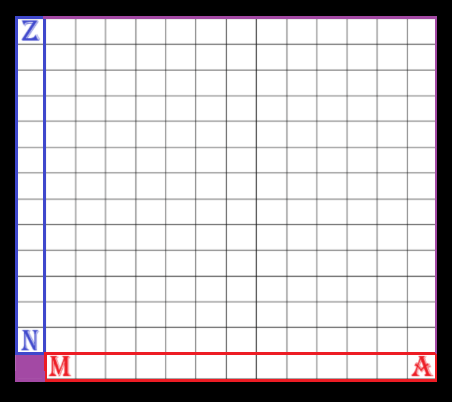
The foundational step to learning our system is to be able to number the 26 letters of the Alphabet with our numbers.
They are seen here below in the red and blue numbers. The Purple “013” is shared by the:
“X-axis” M, and the “Y-axis” N.

The first 13 retain their number.
They make up the “X-axis” (RED) on the bottom.
“M” = 013,
“L” = 012,
“K” = 011,
“J” = 010,
“I” = 009,
“H” = 008,
“G” = 007,
“F” = 006,
“E” = 005,
“D” = 004,
“C” = 003,
“B” = 002,
“A” = 001.
(We use three digits to keep the charts as uniform as possible)
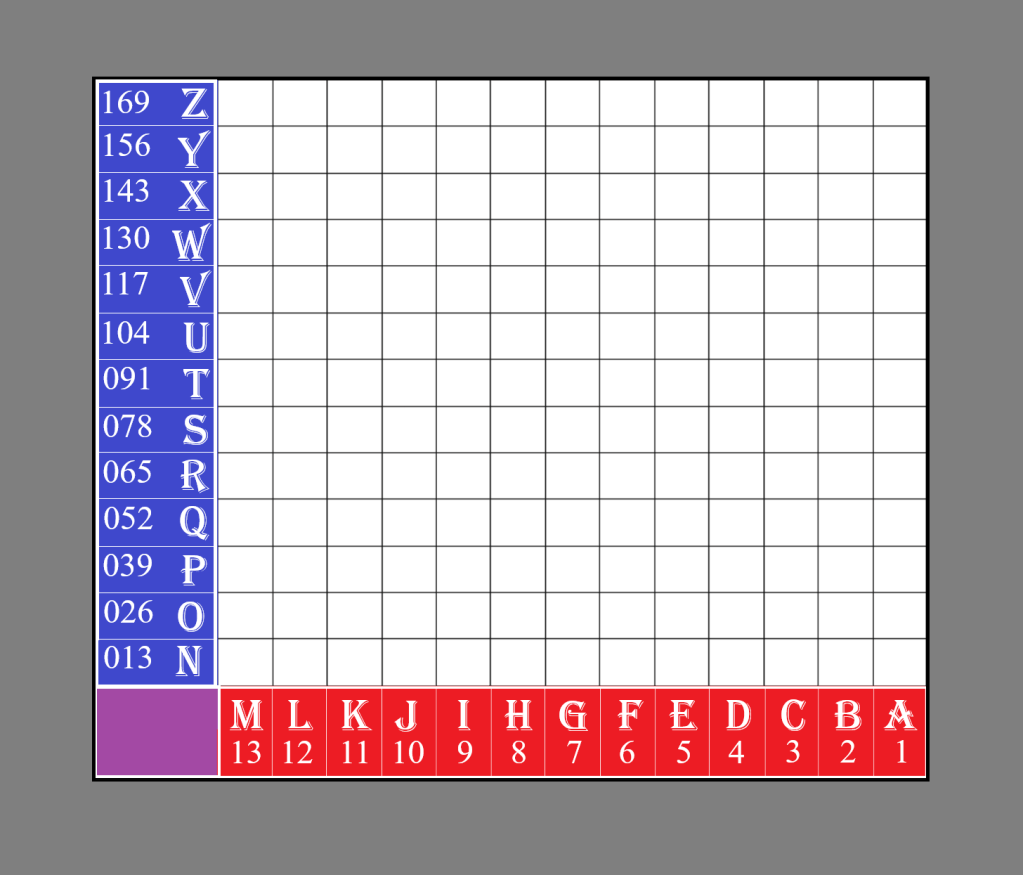
Begin with the number 13 and add 13 until reaching 169. These are the “M-Column” numbers. As seen in the image above. Each column works the same way, but with different starting numbers.
Every floor is numbered the same. The lowest number is above the “A”, and the highest number is above the “M”. These 13 numbers make up the “N-Floor”.
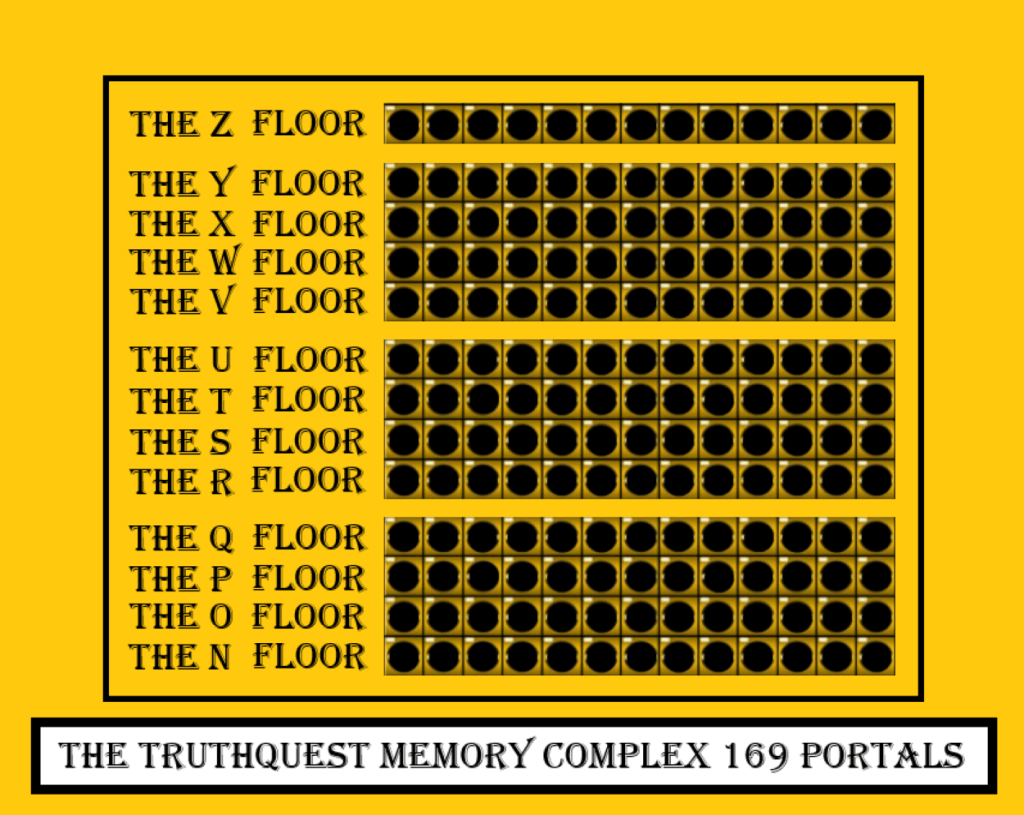
The numbers are sequential from 1 to 169 starting at the bottom right and building up to the top left. Exactly how you would build a 13-story brick building.
Also, it is a mathematical table of 13. Your first memory exercise is to memorize this math table for the number 13. Can you reproduce it on a blank sheet of pager?
* 13 X 13 = 169 (End of the Z-Floor”)
* 12 X 13 = 156 (End of the “Y-Floor”)
* 11 X 13 = 143 (End of the “X-Floor”)
* 10 X 13 = 130 (End of the “W-Floor”)
* 9 X 13 = 117 (End of the “V-Floor”)
* 8 X 13 = 104 (End of the “U-Floor”)
* 7 X 13 = 091 (End of the “T-Floor”)
* 6 X 13 = 078 (End of the “S-Floor”)
* 5 X 13 = 065 (End of the “R-Floor”)
* 4 X 13 = 052 (End of the “Q-Floor”)
*3 X 13 = 039 (End of the “P-Floor”)
* 2 X 13 = 026 (End of the “O-Floor”)
* 1 X 13 = 013 (End of the “N-Floor”)
The blank graph is 14 X 14. If you have a printer, you can copy and paste these to use as worksheets.

Use these as a “CLUE” help.

You should not proceed until you can successfully complete this 169-location graph from the memory clues. Check your numbers with this chart.
____________________________________________
Before moving on to “The Memory Story”, make sure that you complete the Therapy Sessions in the:
“Session-by-Session Guide”
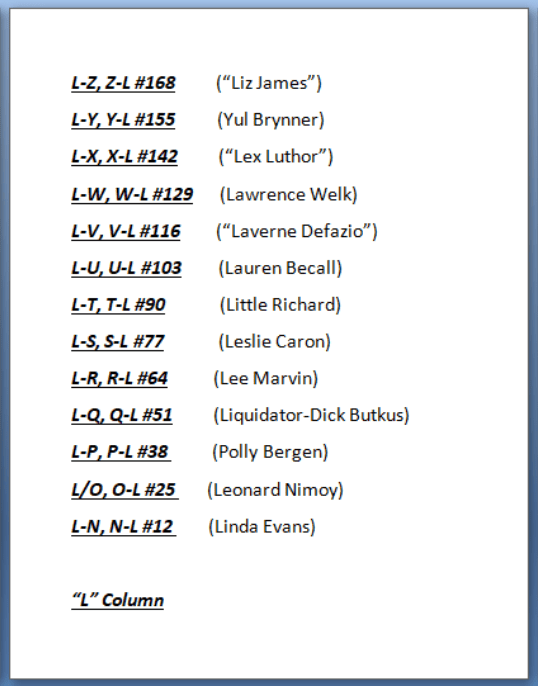
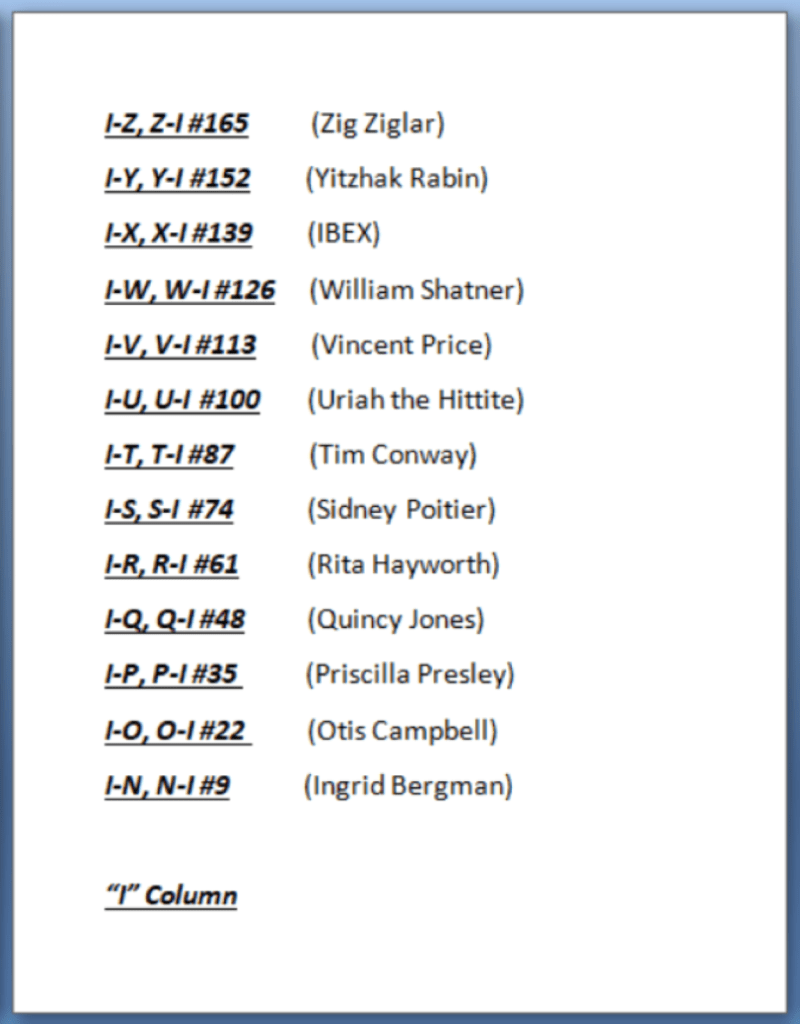
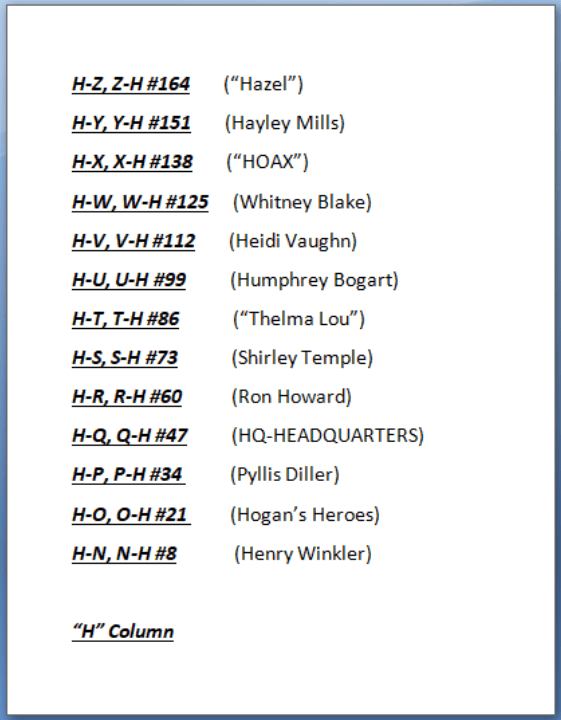
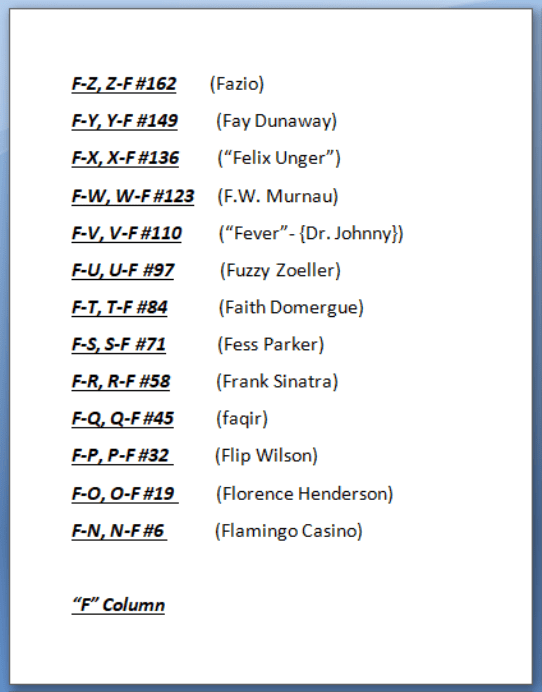
Below are the 13 Columns examples. These need to be changed for each person, to the most powerful “Memory Anchor” possible. Everyone’s life experiences vary.





 TruthQuest International LLC; Bible Study Network