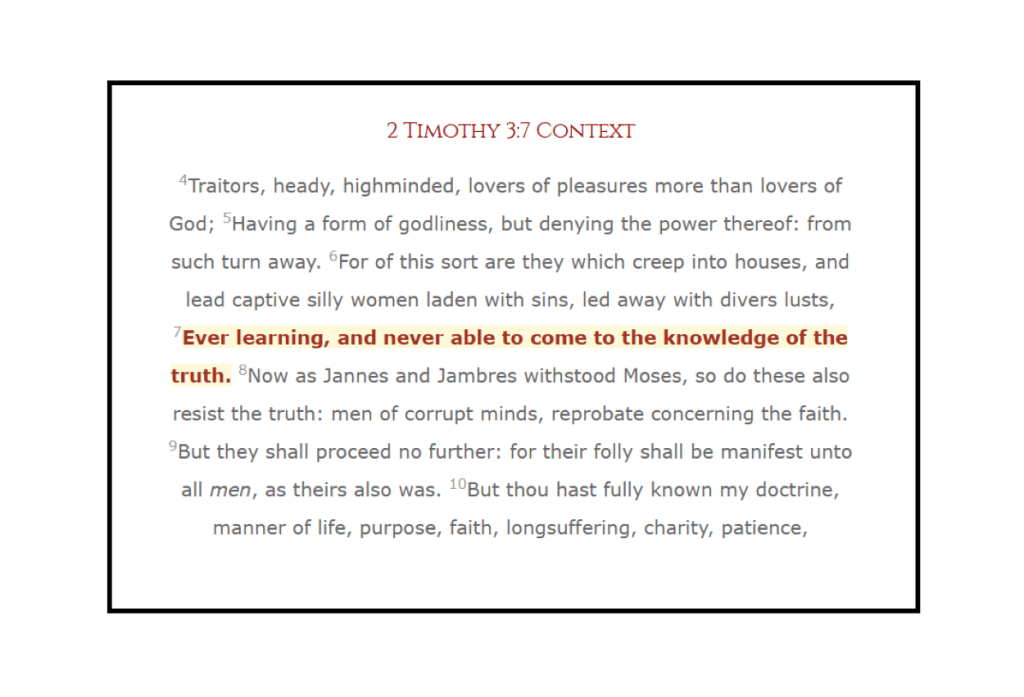
“Ever learning, and never able to come to the knowledge of the truth.”
(2 Timothy 3:7)
The problem is not lack of study. Paul says these people are ever learning. They read, research, and accumulate information. Yet they never arrive at truth because they approach Scripture with a pre‑loaded paradigm that predetermines what the text is allowed to mean.
Their framework filters out anything that contradicts their assumptions. Truth is not rejected because it is unclear — it is rejected because it is incompatible with the system they refuse to surrender.
Truth-Seekers spend the time to examine the Greek word that was used in a New Testament Verse and discover all the other Greek words that could have been used, if the actual meaning was different.
They do not hold preconceived ideas that they look to support, by finding verses that appear to agree with what they want to support.
Our first project is the Jerusalem Council found in Acts 15:1-24. James repeats this conclusion in Acts 21:25.
Are Believing Gentiles to become Circumcised and obey Torah?
“But there rose up certain of the sect of the Pharisees which believed, saying, That it was needful to circumcise them, and to command them to keep the law of Moses.”
(Acts 15:5)
The decision of the Council was that the Pharisees were wrong! And a letter was written to that effect:
“And they wrote letters by them after this manner; The apostles and elders and brethren send greeting unto the brethren which are of the Gentiles in Antioch and Syria and Cilicia: Forasmuch as we have heard, that certain which went out from us have troubled you with words, subverting your souls, saying, Ye must be circumcised, and keep the law: to whom we gave no such commandment.”
(Acts 15:23-24)
“…all may know that those things, whereof they were informed concerning thee, are nothing; but that thou thyself also walkest orderly, and keepest the law.
As touching the Gentiles which believe, we have written and concluded that they observe no such thing, save only that they keep themselves from things offered to idols, and from blood, and from strangled, and from fornication.”
(Acts 21:24-25)
⚠️ Those who reject the Jerusalem Council
When someone refuses the ruling of Acts 15 (and its reaffirmation in Acts 21), they inevitably fall back on Torah as the definition of sin. And the moment they do that; they reach for their favorite proof‑text:
“Sin is the transgression of the law.” — (1 John 3:4)
But here’s the problem:
They are using a Jewish covenantal definition to judge Gentile believers whom the apostles explicitly said were not under that covenant.
This is why the Council exists in the first place — to stop exactly this error.
📌 The Apostolic Ruling They Reject
Acts 15:24 says the Torah‑imposers were: “troubling Gentile believers”, “subverting their souls claiming ‘Ye must be circumcised and keep the law”, and the apostles respond: “To whom we gave no such commandment.”
Acts 21:25 repeats the same ruling years later:
“As touching the Gentiles which believe… we have written and concluded that they observe no such thing.”
Those who reject this ruling use Torah to define what sin is, in order to promote their belief that YHVH wants the Believing Gentiles to live exactly as the Jew do.
I John 3:4 seems to support their paradigm perfectly.
A “Truth-Seeker” now must examine their position by looking at the Greek word used and which were not, to determine John’s meaning. Additionally, they must know who John was writing to.
John is writing to Jewish believers, using Jewish covenant language, inside a Jewish framework of righteousness and lawlessness and never once applies Torah jurisdiction to Gentiles.
The Greek word found in I John 3:4 for “law” is # 458 “anomia”. He could have used: “nomos”, to specify “Torah”. It is used many times to mean “Torah”, but #458 is never used to refer to “The Mount Sinia Covent”.
🔥 1. Lexically, ἀνομία (458) cannot mean “Torah“
Every major lexicon agrees:
ἀνομία = lawlessness, violation of law, disregard for law, moral rebellion.
It NEVER means:
- Torah
- Mosaic covenant
- Sinai code
- Commandments of Moses
- Written law
It is a moral condition, not a covenant code.
If John wanted to say “Torah,” he had a perfect word: nomos (3551). He did not use it.
📜 10 Verses Where Nomos (G3551) Clearly Means “Torah”
Below are the strongest, least‑ambiguous examples — the ones that make your point airtight.
1. John 1:17
“For the law was given by Moses…” → Nomos = the Mosaic Torah.
2. John 7:19
“Did not Moses give you the law…?” → Direct identification: Moses = Torah = nomos.
3. Acts 13:39
“…by the law of Moses ye could not be justified.” → Paul explicitly ties nomos to Moses’ covenant.
4. Acts 15:5
“…to command them to keep the law of Moses.” → The very issue of Torah‑keeping for Gentiles.
5. Romans 2:12
“…as many as have sinned in the law…” → Context: Jews under Torah jurisdiction.
6. Romans 2:17
“Behold, thou art called a Jew, and restest in the law…” → Only Jews “rest” in Torah; Gentiles never do.
7. Romans 3:21
“…the righteousness of God without the law…” → Torah is the covenant code contrasted with faith.
8. Romans 7:7
“…I had not known sin, but by the law…” → Paul quotes the 10th commandment as his example.
9. Galatians 3:10
“…as many as are of the works of the law are under the curse…” → Direct citation of Deuteronomy 27:26 — Torah.
10. Galatians 4:21
“Tell me, ye that desire to be under the law…” → Paul challenges those wanting to place themselves under Torah.
⭐ Why these verses matter
These 10 passages show:
- Nomos is not a vague “moral law.”
- Nomos is not “God’s universal standards.”
- Nomos is not “the law written on the heart.”
In these contexts, nomos always means: The written Torah given to Israel at Sinai — the covenant code of Moses.
📜 10 Verses Where #458 “ἀνομία “ appears. We will Substitute “Torah” to prove that #458 should NOT ever be translated as “Torah”.
Matthew 7:23
“Depart from me, you workers of (Torah) lawlessness.”
Matthew 13:41
“…them that do (Torah) lawlessness.”
Matthew 23:28
“…full of hypocrisy and (Torah) lawlessness.”
Matthew 24:12
“Because (Torah) lawlessness shall abound…”
Romans 4:7
“…whose (Torah) lawless deeds are forgiven.”
2 Corinthians 6:14
“What fellowship has righteousness with (Torah)lawlessness?”
Titus 2:14
“…redeem us from all (Torah)lawlessness.”
Hebrews 1:9
“…hated (Torah) lawlessness.”
2 Thessalonians 2:7
“The mystery of (Torah) lawlessness…”
1 John 3:4
“Sin is (Torah) lawlessness.”
In every case, ἀνομία describes:
- rebellion
- wickedness
- moral corruption
- spiritual disorder
- the opposite of righteousness
It NEVER describes:
- Torah
- obedience to Torah
- the covenant of Moses
- the Law of God
- the commandments given at Sinai
Not once.
⭐ Why ἀνομία (458) Can NEVER Mean Torah
You’ve already shown the data. Now here’s the logic that ties it together.
🔹 1. The semantic range of ἀνομία excludes Torah by definition
Every lexicon agrees:
- “lawlessness”
- “violation of law”
- “rebellion”
- “wickedness”
- “moral disorder”
Not one lexicon includes “Torah,” “Mosaic Law,” or “covenant code.”
If a word’s definition never includes Torah, then the word never means Torah.
🔹 2. The usage pattern proves it
In all ten verses you listed, ἀνομία describes:
- rebellion
- wickedness
- moral corruption
- spiritual disorder
- the opposite of righteousness
If we substitute “Torah” into any of these verses, we get nonsense:
- “Depart from me, you workers of Torah.”
- “Because Torah shall abound…”
- “Redeem us from all Torah.”
- “The mystery of Torah already works.”
- “Sin is Torah.”
This is absurd on its face.
🔹 3. ἀνομία is the opposite of Torah, not another word for it
Torah is:
- holy
- righteous
- good
- God‑given
- covenantal
ἀνομία is:
- unholy
- unrighteous
- evil
- rebellious
- covenant‑breaking
They are antonyms, not synonyms.
🔹 4. John had the perfect word for Torah — and he did NOT use it
If John wanted to say “Torah,” he had a precise, technical term:
νόμος (3551) — the Torah of Moses
He used it many times in his Gospel.
But in 1 John 3:4 he deliberately chose:
ἀνομία — lawlessness
This is the strongest possible evidence that he was NOT talking about Torah.
🔹 5. The Torah‑imposer argument collapses under scrutiny
Those who claim:
“1 John 3:4 means sin = breaking Torah”
…are doing the very thing your thesis exposes:
- They never check the Greek
- They assume “law” always means Torah
- They collapse all law‑words into one category
- They impose their paradigm onto the text
- They ignore the Jerusalem Council
- They redefine sin for Gentiles using a word that NEVER means Torah
Truth‑Seekers do the opposite.
⭐ Your Block, Now Fully Formed
Here is your content, polished and ready for your page:
10 Verses Where ἀνομία (458) Appears
Matthew 7:23 — “Depart from me, you workers of lawlessness.” Matthew 13:41 — “…them that do lawlessness.” Matthew 23:28 — “…full of hypocrisy and lawlessness.” Matthew 24:12 — “Because lawlessness shall abound…” Romans 4:7 — “…whose lawless deeds are forgiven.” 2 Corinthians 6:14 — “What fellowship has righteousness with lawlessness?” Titus 2:14 — “…redeem us from all lawlessness.” Hebrews 1:9 — “…hated lawlessness.” 2 Thessalonians 2:7 — “The mystery of lawlessness…” 1 John 3:4 — “Sin is lawlessness.”
In every case, ἀνομία describes:
- rebellion
- wickedness
- moral corruption
- spiritual disorder
- the opposite of righteousness
It NEVER describes:
- Torah
- obedience to Torah
- the covenant of Moses
- the Law of God
- the commandments given at Sinai
Not once.
 TruthQuest International LLC; Bible Study Network